
2026/10/08

Robots are entering an era of "more and more data."
Open-source datasets keep emerging. Different data production methods — real-world collection, teleoperation, simulation generation — continue to evolve. And data scale has grown from small-scale experiments of the past toward hundreds of hours, thousands of hours, and beyond.
This is undoubtedly a good thing.
More data means robots have the opportunity to see more tasks, more environments, and more ways of operating — and to learn richer capabilities from them.
But as data scale grows, a question that was once easy to overlook is starting to matter:
We know how much data we have. But do we know how accurate it actually is?
Behind this lies an important concept in robot training and evaluation:
Robots now come equipped with increasingly rich sensors.
Cameras "see." IMUs perceive motion states. Joint encoders record joint positions. Together, different sensors help a robot understand itself and the world around it.
But there is a crucial distinction here:
What a robot "perceives" is not inherently the same as what actually happens.
Take the simplest example.
The robot's control system believes the end-effector has moved 50 centimeters.
So how far did it actually move?
A vision algorithm determines that an object is located at a certain position.
Where is its true 3D position?
In simulation, the robot completes a motion accurately.
After deployment to the real robot, how much deviation emerges between the actual execution trajectory and the simulated one?
These questions are sometimes difficult to answer independently using only the robot's own data.
Because:
If we rely solely on the data of the system under test to judge whether it is accurate, we lack an independent "ruler."
This is precisely the significance of Ground Truth.
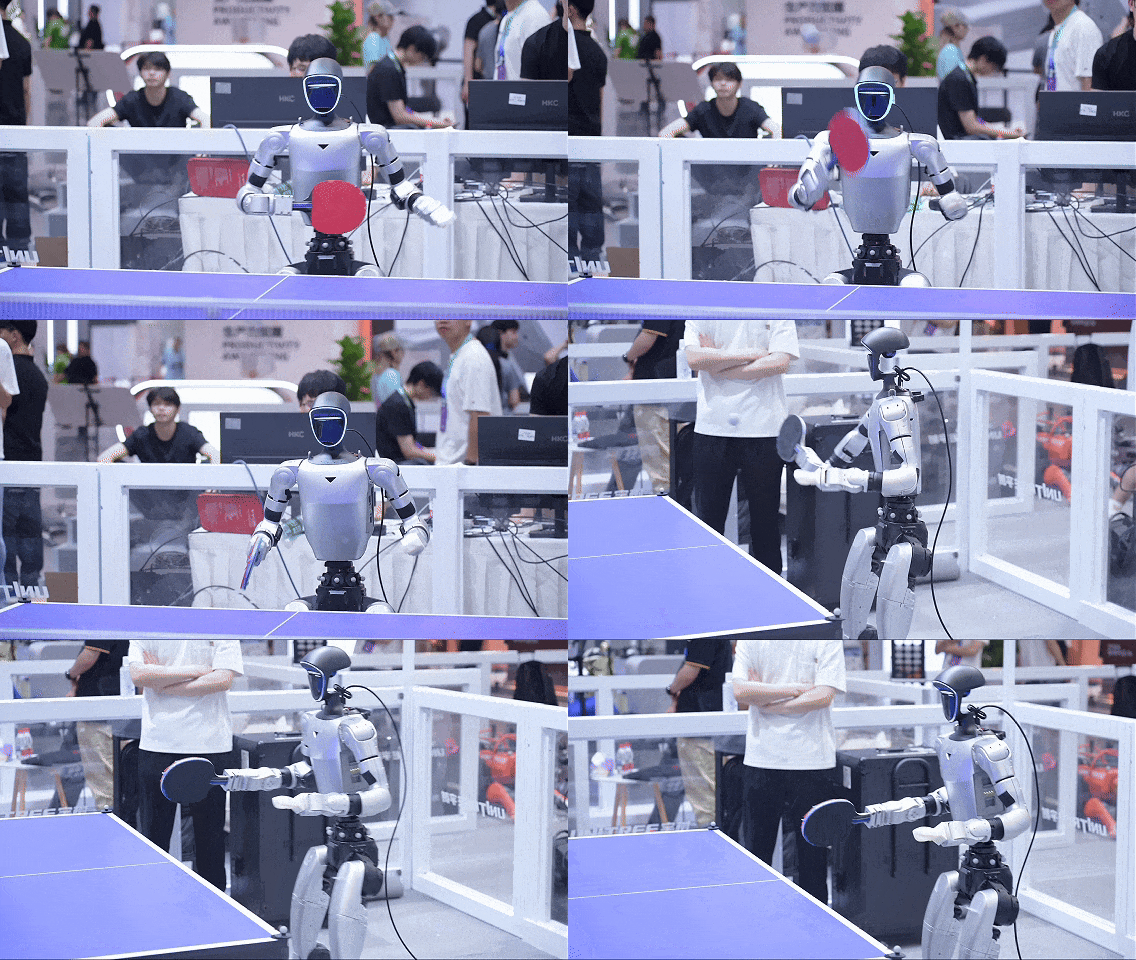
Ground Truth is not a particular data format, nor is it simply adding another sensor.
What matters more is this:
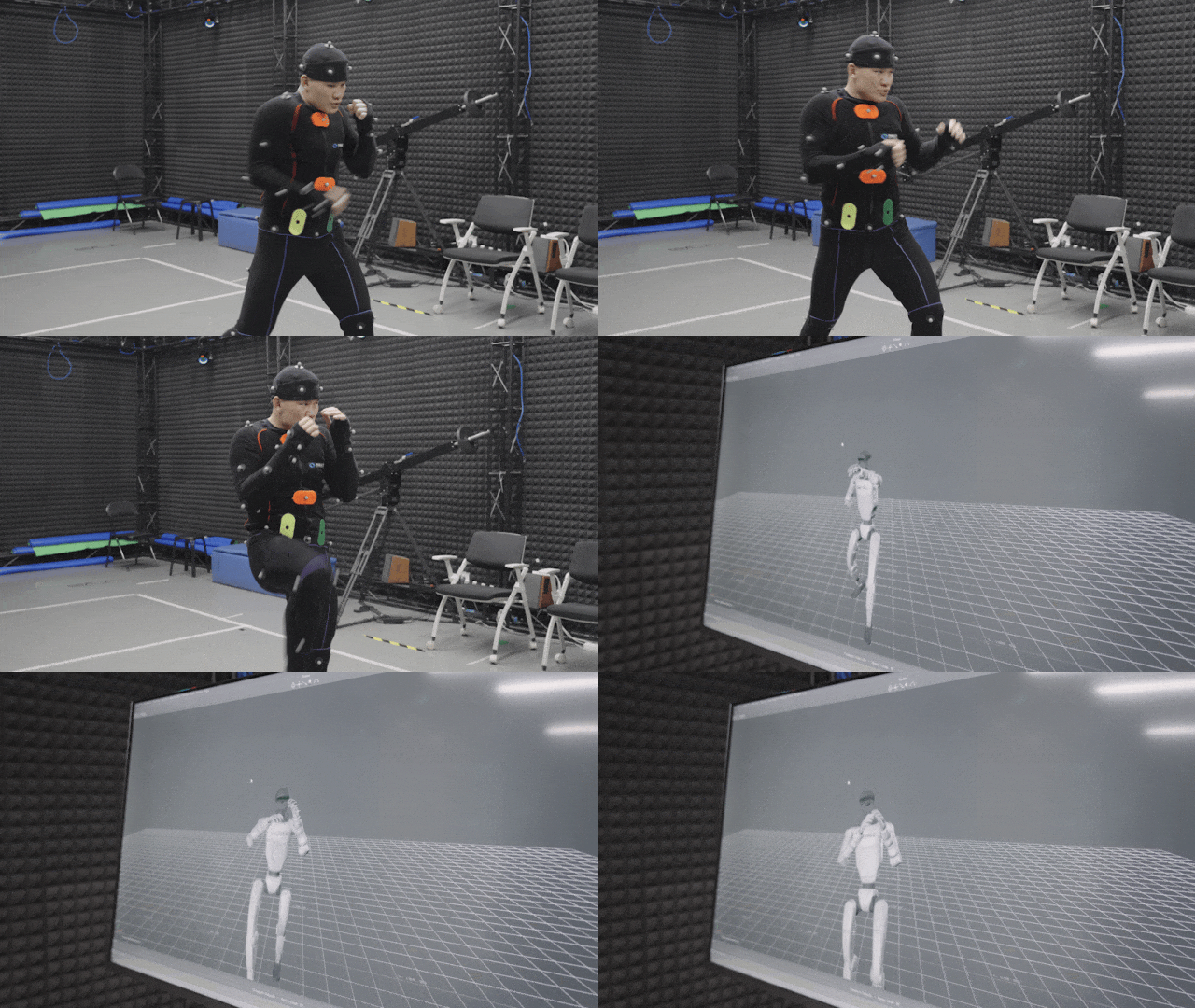
For example, during robot motion, an external high-precision measurement system can capture the true position, posture, and motion trajectories of the robot and target objects.
We then have two sets of data:
Robot's own perception data
↓
"Where I think I am, and how I think I'm moving"
External ground truth data
↓
"Where it actually is, and how it actually moves"
By comparing the two, many questions that were previously difficult to answer start to become quantifiable.
Is localization actually accurate?
How large is the trajectory error?
How far does the visual recognition result deviate from the true position?
Is the result consistent when the same motion is executed repeatedly?
After Sim-to-Real, how much deviation emerges in actual execution?
What Ground Truth truly provides is not "more data."
It is a reference coordinate for judging whether other data is accurate.
In the small-scale experiment stage, an anomalous data point was often easy to spot.
But as robot training moves into the stage of scaled data production, the problem becomes different.
If there is a positional deviation, if different sensors are not accurately synchronized, if there is an error between an object's true posture and the recorded result...
Once these errors enter the training pipeline, they do not automatically disappear just because the data volume grows.
They may even be scaled up along with it.
So as the industry increasingly focuses on:
"How many hours of data do we have?"
Another question also deserves to be put on the table:
This is not a denial of the value of data scale.
Quite the opposite.
The larger the scale, the more we need to understand data quality; the more important the data, the more we need to know its error relative to the real world.
Therefore, the development of robot data may be entering a new dimension:
From pursuing more data,
toward pursuing more trustworthy data.
This is also one of the reasons motion capture is becoming increasingly valuable in robotics.
In the past, when people thought of motion capture, the first thing that came to mind was:
Recording motion.
But in robot R&D, high-precision optical motion capture plays another important role:
Measuring motion as it actually happens.
Through an optical measurement system independent of the robot itself, it can continuously track the position, posture, and motion trajectories of the robot, end effectors, target objects, and other entities within a unified spatial coordinate system.
It does not participate in the robot's own perception or judgment, nor does it rely on the robot to tell us "where it thinks it is."
Instead, it stands outside the system, providing a separate high-precision motion reference.
This enables optical motion capture to further serve robot R&D across:
Data acquisition → Ground truth measurement → Result comparison → Error analysis
This is also a capability CHINGMU continues to expand in robotics:
From capturing motion, to measuring motion; from producing data, to providing external ground truth.
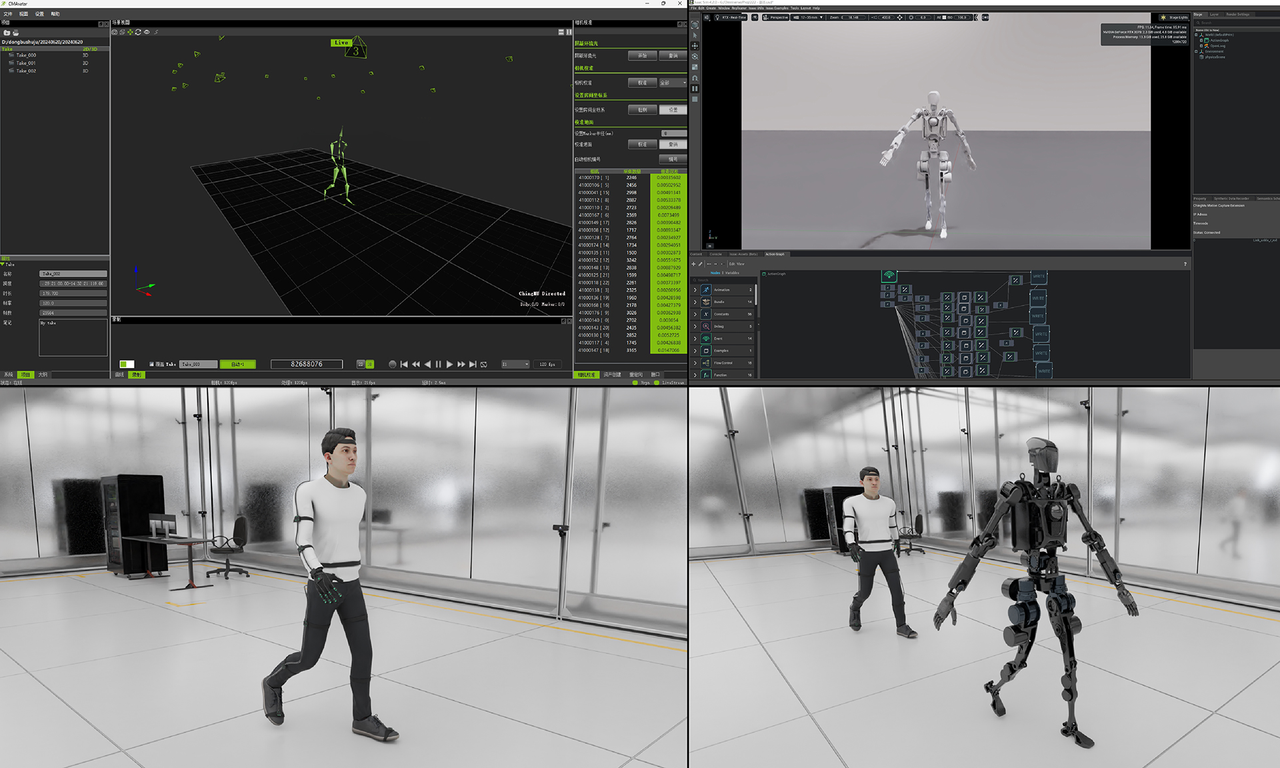
If we look further along the robot R&D pipeline, Ground Truth can actually play a role at different stages.
Data Acquisition Stage
Through external high-precision measurement, it provides motion references in a unified space for robots, humans, and target objects.
↓
Algorithm Validation Stage
Algorithm outputs are compared against external measurement results to quantify errors in localization, trajectory, posture, and more.
↓
Training & Deployment Stage
Observe the differences between a robot's actual execution results and the target motion.
↓
Robot Evaluation Stage
Real-world motion is further transformed into quantifiable metrics that can be compared and analyzed.
So the value of Ground Truth is not just about answering:
"Is the data accurate?"
Ultimately, it can also answer:
"Has the robot learned accurately?"
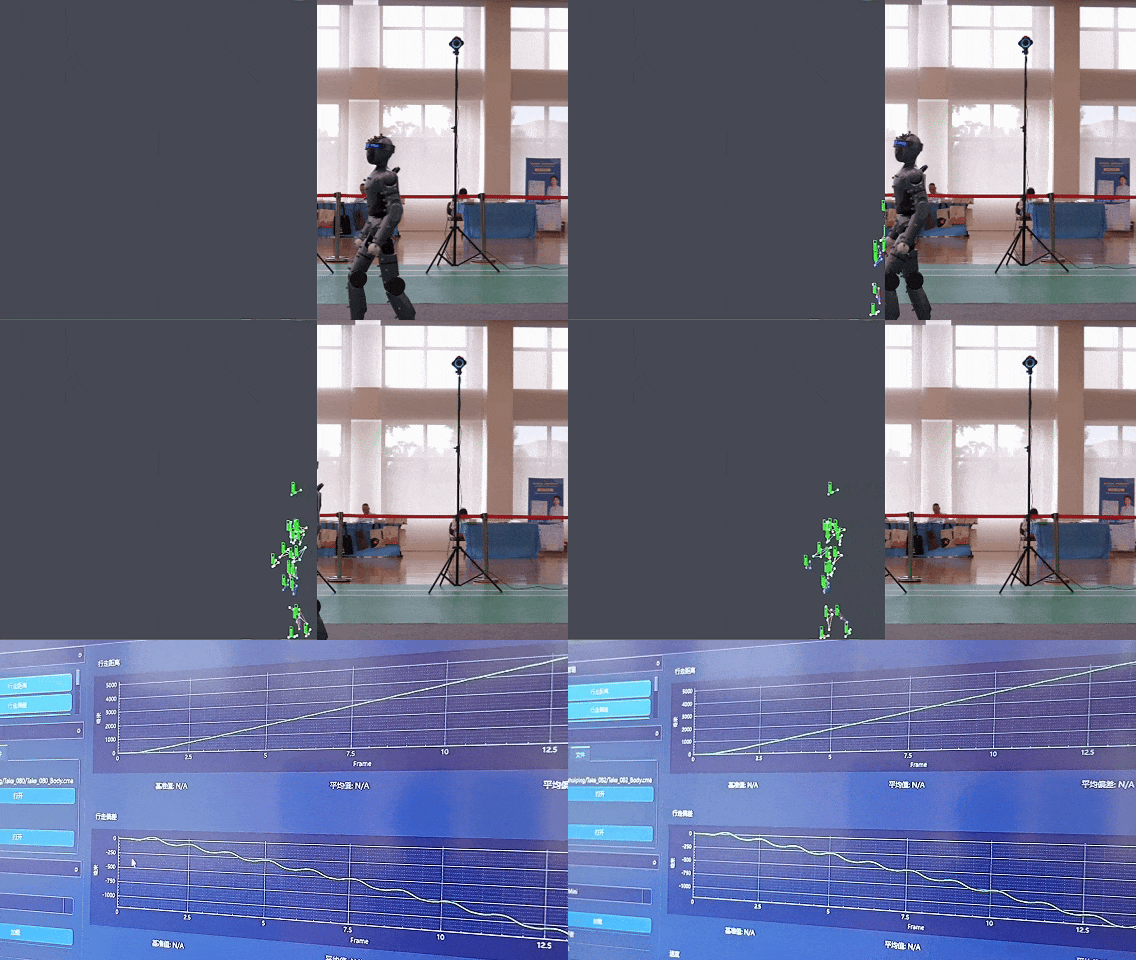
When external ground truth is further brought into robot motion evaluation, a more complete validation pipeline can be formed.
Building on high-precision optical motion capture and robot motion analysis capabilities, CHINGMU has launched the RoboEval Robot Motion Evaluation Platform.
What it aims to solve is an increasingly specific question in robot R&D:
How much of a gap exists between what the robot actually does and what we want it to do?
Through external high-precision motion measurement, the robot's actual execution data is obtained, and motion analysis is further conducted — moving motion performance from naked-eye observation toward objective data.
Real-world motion
↓
External measurement
↓
Ground Truth
↓
Deviation analysis
↓
Motion evaluation
This makes robot capabilities more:
measurable · quantifiable · comparable · verifiable
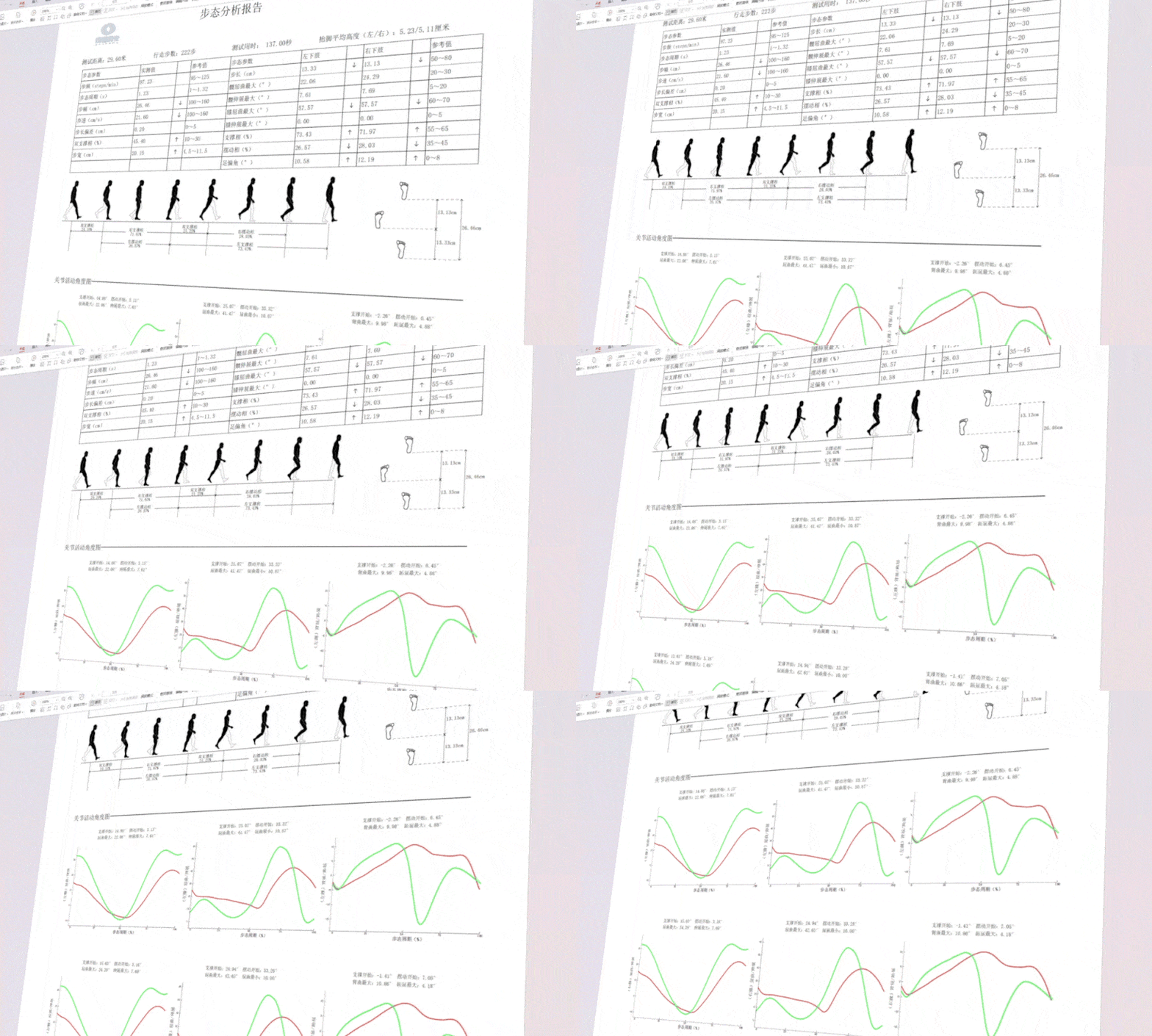
The idea that robots need massive amounts of data is becoming an increasingly broad consensus.
But once data reaches scale, we may also need to build another awareness:
"Having data" solves whether a robot has something to learn from; "having ground truth" solves whether we know how accurate that data and those results actually are.
As robots move ever deeper into the real world, and as training, deployment, and evaluation gradually form a complete pipeline, an independent, objective, high-precision external reference will only become more important.
Because no matter how many hours or how many entries the data reaches,
one most fundamental question can never be avoided:
And this may be precisely the most important value of Ground Truth.
Delivering objective external ground truth for robot R&D through high-precision motion measurement.
From data acquisition, to training validation, to robot motion evaluation —
making the real world accurately measurable.
How Can AI‑Art‑Education Initiatives Be Put Into Practice? CHINGMU Motion‑Capture Solutions for University Training and Creative Competitions





+86-21-56472866 / 13310099680
1190 Nong METACINE (South Gate), Building 1, CHINGMU, Zhengtai Road,Baoshan District, Shanghai

Hot searches: Motion capture, Optical motion capture, Motion capture system robot, Motion capture, Bionic robot, Motion control, Gait analysis, Rehabilitation training action assessment, Animation production, Virtual idol live streaming, Expression capture, Virtual production, Pre-visualization, Performance capture