
2026/11/17

Incoming ball, swing, return; move, yield, coordinate...
As one robot completes a shot, the other is already stepping forward. The teammate who just swung must yield space in time and rush back to their position for the next hit. This is a scene from PingpongDuo, the first humanoid robot table tennis doubles system officially released by Archon Robotics, playing on a real table.
For human players, alternating hits in doubles is a basic skill. For robots, it combines high-speed perception, whole-body motion control, and dual-robot coordination into a single challenge.
In this research, CHINGMU provided a high-precision optical motion capture system to support human motion data acquisition, table tennis ball and paddle tracking, simulation parameter calibration, and real-robot motion state measurement—giving robot motion learning a reference, model training a basis, and real-world performance the ability to be measured and validated.
Part 01
In robot table tennis scenarios, CHINGMU is already a "regular player."
From human-robot matches to robot-robot matches, from domestic stages to international venues, our high-speed motion tracking and real-robot measurement capabilities have been validated across multiple projects, accumulating mature application experience for different systems. Every continuous rally relies on the combined efforts of perception, algorithms, control, data, and hardware. These experiences also lay the foundation for new challenges.
This time, Archon Robotics placed two robots on the same side of the table. The task gained another layer: hit your own ball, and leave a good next shot for your teammate.
Table tennis doubles has a clear rule: the two players on the same team must alternate hits. Even if the ball flies right at you, if it's not your turn, you must leave that shot to your teammate.
Thus, the two robots must simultaneously consider the incoming ball, their own motion states, and their teammate's state within a limited space.
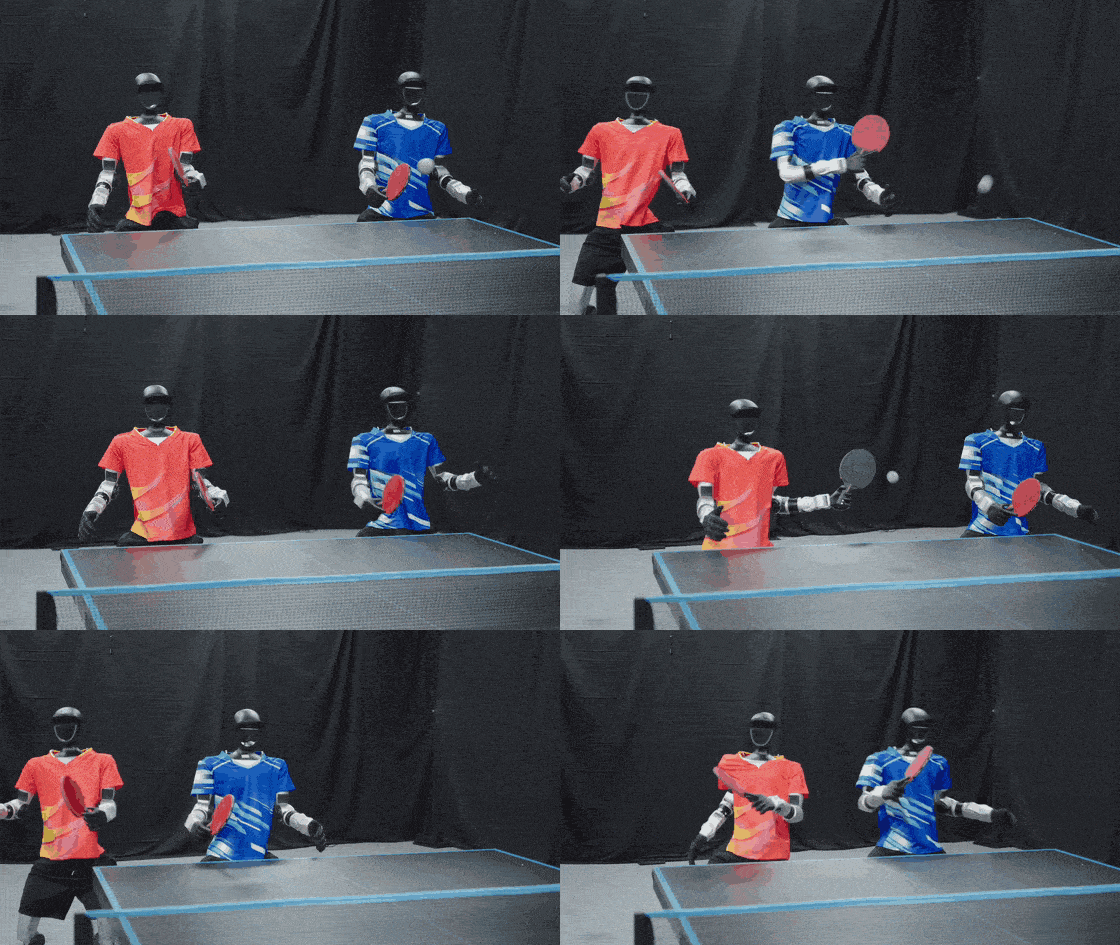
Insufficient yielding might block a teammate or even cause a collision; yielding too far might make it impossible to catch the next shot. Rapid lateral movement also changes body posture and velocity, affecting the paddle's position and orientation at the moment of contact.
This collaborative effort requires solving three problems simultaneously:
l See accurately. Acquire reliable state information for the ball and robots to provide a basis for trajectory prediction and motion planning.
l Connect seamlessly. Continuously link movement, braking, and swinging, adapting to the posture and velocity left by the previous action.
l Coordinate well. Arrange positioning according to the alternating hit rule, making space for teammates while keeping room to return for your next shot.
PingpongDuo's approach: incoming ball triggers positioning planning, while low-level control continuously executes it. With each incoming ball, the team planner simultaneously selects lateral positioning targets for both robots; a learned risk model evaluates whether any body parts of the two robots might come excessively close or risk collision while executing candidate positions.
If the predicted risk exceeds the threshold, the system adjusts the candidate positions, aiming to retain the current striker's target and having the teammate make more positional adjustments. It's like a tacit position exchange in doubles: prioritize the current shot, then make space for the next.
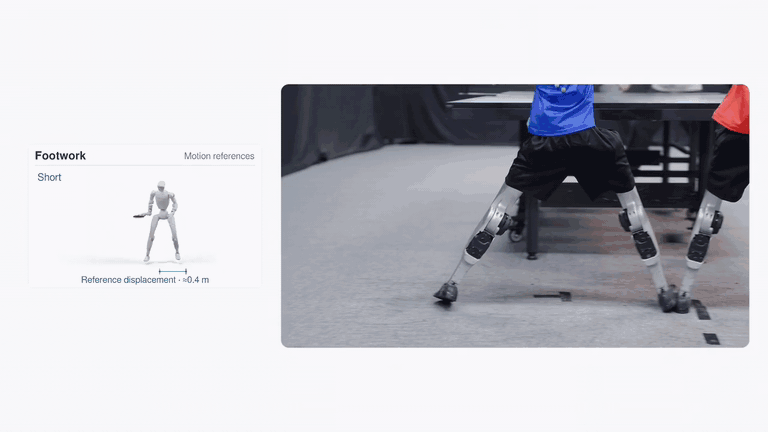
Another clever design is that both robots can share the same control policy. By applying left-right mirroring to observations, commands, reference motions, and joint actions, the system enables the two robots to complete hits and yield space symmetrically, eliminating the need to train two separate control policies.
Simulation comparison results show that, under the same learned risk filter, the learned joint positioning strategy increased the average number of consecutive legal returns from 3.79 to 4.87 compared to rule-based positioning strategies. That's right—teamwork matters for robots too!
Part 02
Behind every coordination on the table is a complete R&D pipeline: acquiring real motion, calibrating the simulation environment, training control policies, and returning to real robots for execution and validation.
In the research practice of PingpongDuo, CHINGMU's optical motion capture system consistently supports and runs through these stages. The same real-world motion data serves different tasks at different stages.
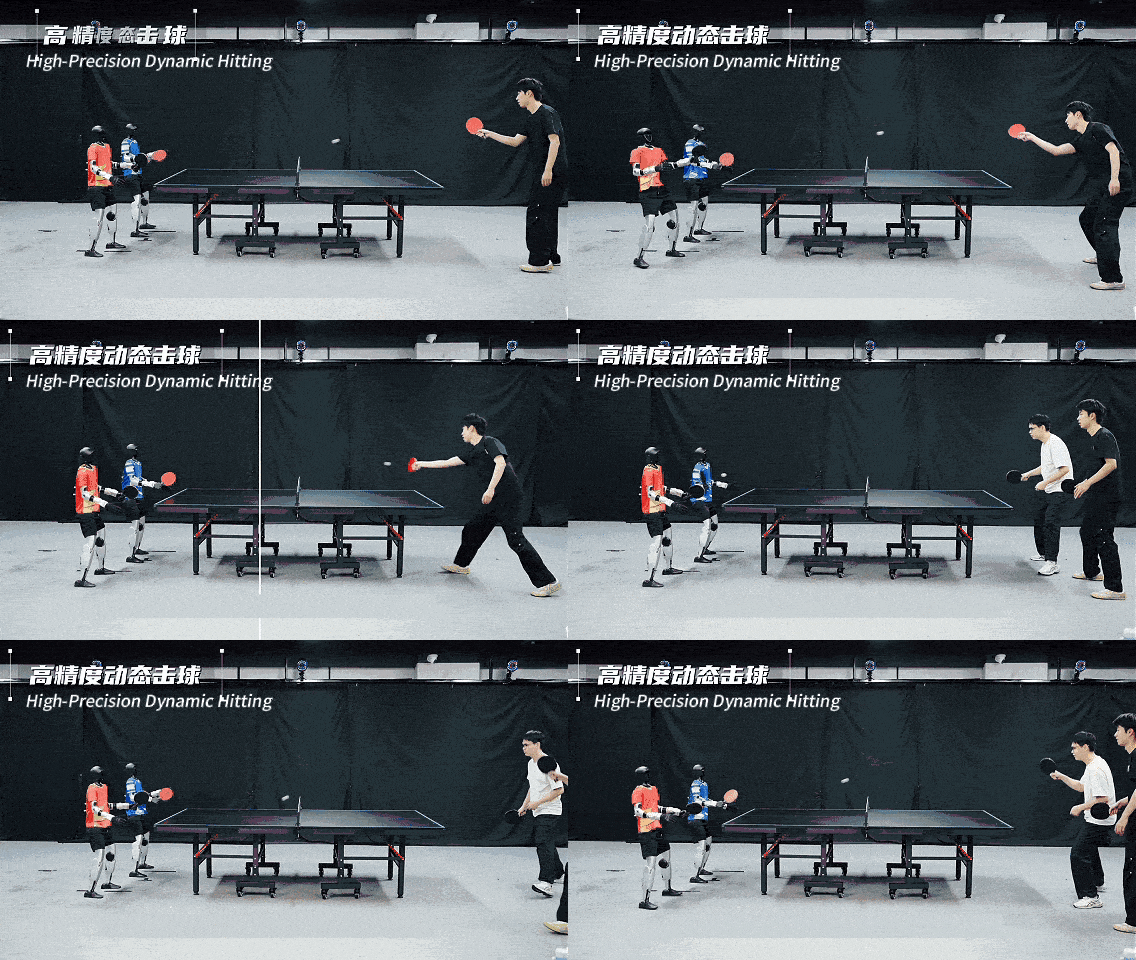
Step 1 Real Human Motion: How Do Robots Learn to Yield Space for Teammates?
When humans play doubles, there's a lot of experience hidden in their footwork: when to step sideways, when to pull back, how to make space after hitting, and how to return to position for the next shot.
These are hard to explain in words, but they can be recorded.
Archon Robotics used the CHINGMU mocap system to capture the full-body motion of human doubles players, cutting it into approximately 200 footwork segments covering three categories: shot preparation, non-striker yielding, and returning to position. These were then retargeted to the robots' physical structure.
The robots then learned in training to track target positions and velocities, maintain balance, and brake and wait once in position.
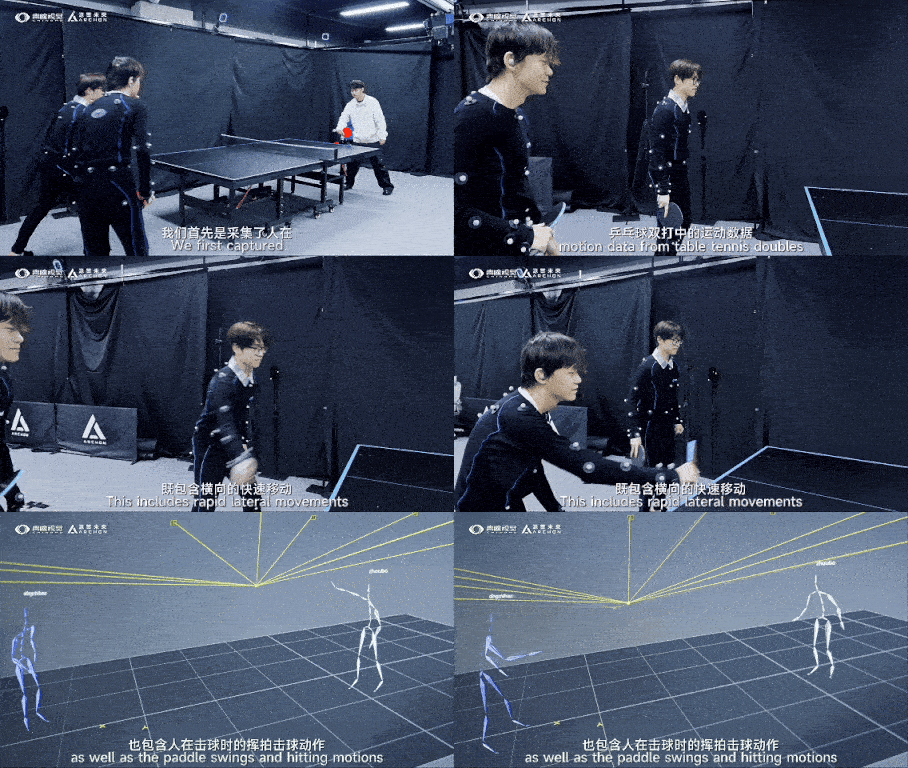
Next, they had to master the transitions between actions. When a swing ends, the body may still be rotating; when the next ball arrives, the footwork may not have completely settled. The research team trained the footwork starting from the body state at the end of a shot, and also trained the hitting to adapt to the posture and velocity left by movement, allowing the two types of skills to switch continuously.
Thus, real human motion is transformed from an on-site demonstration into a reference for robots to learn footwork and whole-body coordination.
Step 2 Real Ball Motion: How Can a Ping-Pong Ball in Simulation Act More Like the Real Thing?
Previous robot table tennis research mostly used ball-less paddle target tracking; PingpongDuo actually introduced the ball into the simulation scene, using return results to train motion corrections. Since the ball is in the simulation, it first needs to be close enough to reality.
How the ball decelerates in the air, how it bounces off the table, and where it flies when it hits the paddle—if these processes are not simulated accurately, moves perfected in simulation may miss in reality.
To this end, the research team used CHINGMU's mocap system to record the motion of the real ball and paddle, conducting staged calibration with measured data: first calibrating flight and table bounce, then calibrating paddle collision.
Step one: identify air resistance, table restitution coefficient, and friction parameters through vertical drop and oblique table impact experiments. Vertical drops help determine the accuracy of fall and bounce; oblique impacts provide velocity changes along the table surface to calibrate friction response.
Step two: fix the flight and table parameters, then fit the bounce law of the paddle-ball collision through moving paddle hit experiments. Since the paddle is also moving, calculating the ball's velocity before and after collision requires referencing the velocity of the paddle's contact point.
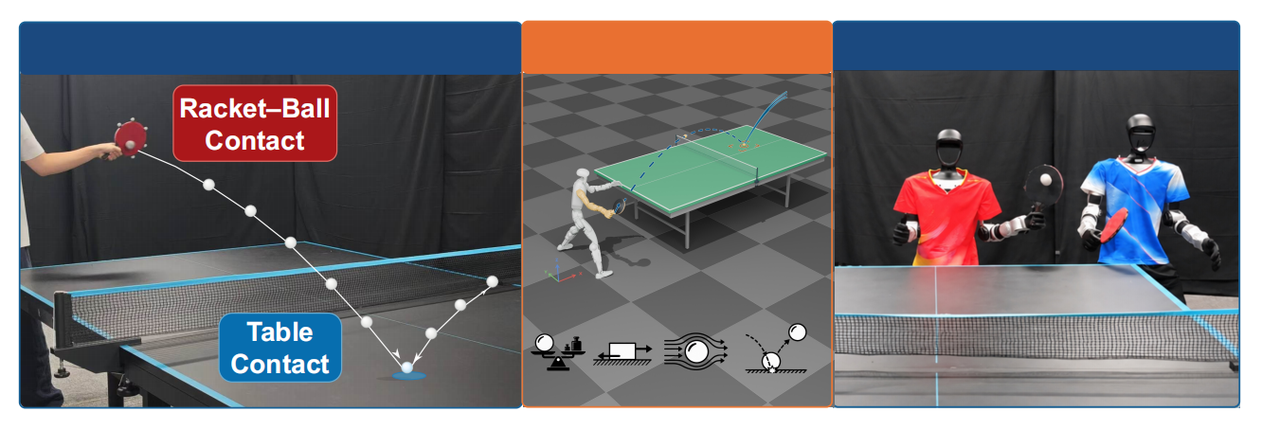
This staged processing reduces error compensation between different models, minimizing the impact of flight model errors on fitting the paddle contact parameters.
After calibration, the simulation environment has a measured basis but still cannot cover all real-world variations. Therefore, during training, parameters such as ball mass, air resistance, friction, and bounce are randomly varied in this environment to help the policy adapt to modeling errors and physical condition changes within a certain range.
In this environment, the training goal is to enable the robot to effectively return the ball even when its body is not yet fully stabilized after rapid movement.
The research team kept the basic skills unchanged, letting the robot move first and then attempt to hit, training only the motion correction of the paddle arm. Whether the paddle touches the ball, and whether the ball clears the net and lands on the opponent's side, all contribute to the training feedback; after a valid return, landing accuracy and net clearance margin are further evaluated. Meanwhile, constraints on paddle tracking, body stability, and correction magnitude are maintained, ensuring motion adjustments balance return effectiveness with motion stability.
Step 3 Real Robot Motion: When Robots Actually Play, How Does the System Know Where They and the Ball Are?
Back on the real table, mocap continues to provide the system with motion state observations of the robots and the ball.
The paper "PingpongDuo: Agile Humanoid Table Tennis Doubles with Safe Team Coordination" published by Archon Robotics explicitly states: "Our real-world system relies on external motion capture to estimate robot and ball states."
This means that external mocap is not only used for post-experiment data analysis but directly participates in the state estimation required for the real-world system's operation.
Under the technical architecture used in this experiment, the high-precision optical motion capture system provided by CHINGMU supports the measurement of the spatial motion states of the robots and the ball, forming a crucial external perception foundation for real-world doubles play.
According to the real-robot experiments published in the paper, the two robots achieved over 10 consecutive alternating hits; a single robot completed a yield-and-return cycle with a total travel distance of 2.15 meters within 2.4 seconds, reaching a peak velocity of 2.23 m/s.
These numbers correspond to the continuous actions happening on the table: hitting, yielding, waiting, returning, and getting ready for the next shot.
System performance comes from the joint efforts of planning, control, training, data, and hardware. The data and measurement support provided by CHINGMU enable the research team to observe real-world states, analyze execution deviations, and continue optimizing accordingly.
From recording human motion, to calibrating ball movement, to measuring robot performance, mocap runs through this R&D pipeline that starts from reality and returns to reality.
This is also the value of CHINGMU's continuous deep cultivation in Embodied AI: making real motion a reference for learning, a basis for training, and a support for experiments.
Part 03
Table tennis doubles is just one specific application scenario, yet it concentrates multiple key issues in robot R&D: how to learn human coordination, how to replicate real physical interactions in simulation, and how to acquire the robot's actual motion states during execution.
PingpongDuo provides a representative research practice for these questions.
The technical collaboration between Archon Robotics and CHINGMU is not limited to table tennis. The two parties will also jointly release technical achievements related to the general System 0 model, further demonstrating the practical application of high-precision mocap technology in the R&D of whole-body robot motion control.
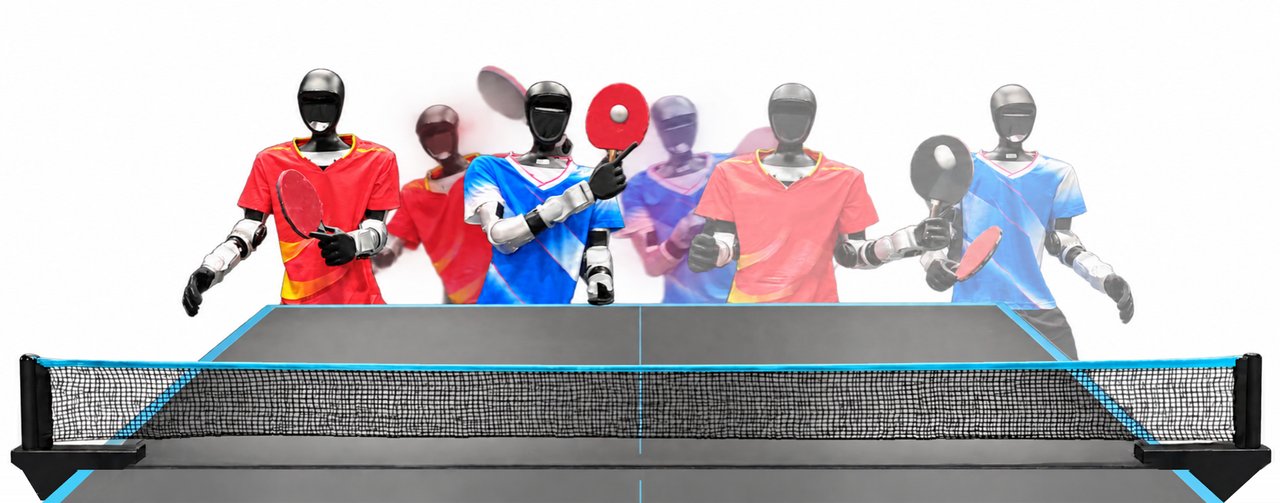
In the R&D of the general System 0 whole-body motion control, CHINGMU's high-precision optical mocap technology also plays an important role: on one hand, it captures full-body human motions under tasks such as different terrains and mobile manipulation to provide motion references for robot training; on the other hand, through real-robot global pose tracking, it provides an external measurement basis for the testing and validation of motion control models.
From real human motion data to robot motion control and real-robot validation, both parties are continuously expanding technical cooperation around the different needs in whole-body intelligence R&D.
From a single table to richer mobile manipulation and complex motion tasks, real-world motion data and high-precision spatial measurement are providing crucial support for robot R&D.
The next stop goes beyond table tennis.
Two Robots, One Seamless Doubles Match! CHINGMU Empowers Archon Robotics to Unlock New Humanoid Robot Gameplay
CHINGMU and Hitch Open Forge Global Strategic Partnership to Advance Physical Intelligence Competitions and Research Applications
Archon Robotics Officially Releases PingpongDuo, with CHINGMU Powering Humanoid Robot Table Tennis Doubles!





+86-21-56472866 / 13310099680
1190 Nong METACINE (South Gate), Building 1, CHINGMU, Zhengtai Road,Baoshan District, Shanghai

Hot searches: Motion capture, Optical motion capture, Motion capture system robot, Motion capture, Bionic robot, Motion control, Gait analysis, Rehabilitation training action assessment, Animation production, Virtual idol live streaming, Expression capture, Virtual production, Pre-visualization, Performance capture