
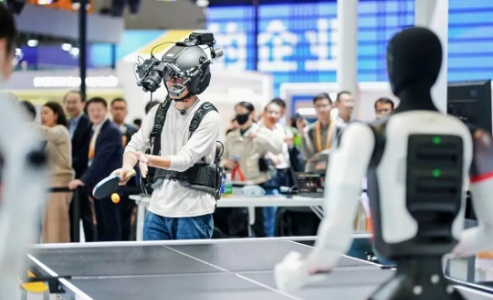
On November 8, 2026, at the Equipment & Technology Exhibition Area of the 9th China International Import Expo, Hangzhou EndlessAI Embodied Intelligence Co., Ltd. and Unitree showcased a humanoid robot dual-robot autonomous ping-pong rally system. Two Unitree G1 humanoid robots stood at opposite ends of the table and achieved stable rallies of 348 consecutive shots, setting a new global benchmark for autonomous ping-pong rallies between two humanoid robots.
The challenge escalates from human-robot rallies to fully autonomous dual-robot rallies. Every shot from one robot becomes a new task for the other to respond to in real time. Both robots must continuously perform perception, prediction, decision-making, movement, stroking and posture adjustment. Any deviation in a single link may break the rally.
High-quality motion data is indispensable for robots to develop such stable continuous rally capability. CHINGMU’s optical motion capture system fulfills this role: it captures the 3D motion trajectories and posture changes of the ball and robots at high precision and high frame rate, delivering a reliable benchmark for EndlessAI’s model training, skill iteration and performance validation.
Table tennis is a highly dynamic and stochastic sport. The ball travels fast with variable trajectories, and constant shifts in spin, speed and landing points impose stringent demands on the robot’s environmental perception, motion prediction, real-time decision-making and full-body coordinated control.
Hitting one ball demonstrates single-shot motion capability; 348 consecutive shots test the whole system’s sustained perception, real-time decision-making and stable execution within a dynamic environment. CHINGMU’s motion capture data forms the foundational layer of this pipeline. It enables robots to “learn” prediction and return strokes from massive real motion data, providing solid references for subsequent full-body control.
The data supports not only this 348-shot world record, but also validates the stable operation of humanoid full-body intelligence in real dynamic scenarios. It brings humanoid robots one step closer to their own AlphaGo moment.


+86-21-56472866 / 13310099680
1190 Nong METACINE (South Gate), Building 1, CHINGMU, Zhengtai Road,Baoshan District, Shanghai

Hot searches: Motion capture, Optical motion capture, Motion capture system robot, Motion capture, Bionic robot, Motion control, Gait analysis, Rehabilitation training action assessment, Animation production, Virtual idol live streaming, Expression capture, Virtual production, Pre-visualization, Performance capture