
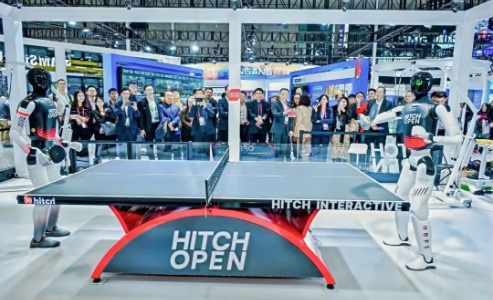
On November 7, 2026, at the Lingang Exhibition Area of the 9th China International Import Expo, the Hitch Open Physical Intelligence Open-Source Platform completed an AI autonomous decision-making robot ping-pong rally challenge. Two humanoid robots rallied up to 142 shots with no manual remote control and no pre-set scripts, breaking the previous world record of 17 shots.
This achievement was jointly accomplished by the research team led by Professor Gao Yue from Shanghai Jiao Tong University and Shanghai Chuangzhi Academy, together with the Hitch Open platform. The record targets dual-robot continuous rallying: robots on both sides of the table make independent decisions. Unlike human-robot rallies with human players as a fallback, both robots need to independently complete perception, decision-making and stroking. It means training two “players” at the same time; any deviation from either side will immediately interrupt the rally, raising the difficulty substantially.
Within this technical pipeline, CHINGMU’s optical motion capture system delivers external spatial perception. A ping-pong ball is small and flies fast, making it hard for the robot’s onboard vision alone to stably capture its 3D trajectory. Enabling robots to perceive dynamic ball paths in real time is one of the biggest challenges of the whole solution. As Allen Yang, Co-founder of Hitch Open, explained: “One major difficulty is enabling robots to perceive changes in surrounding dynamic scenes. We adopted CHINGMU’s flagship product. In our ping-pong lab, it captures the flight trajectory and spin angle of the ping-pong ball at high speed with high precision, covering 360 degrees without blind spots.”
The 142-shot rally is not an isolated demo. Table tennis is a typical high-speed ball sport with a reaction window of only a few hundred milliseconds for each incoming ball. Every shot tests whether the perception-decision-action loop can keep running continuously. Any error in spatial perception breaks the chain.
Sitting at the front end of this loop, CHINGMU’s motion capture system ensures the robots “see accurately” amid fast incoming balls, providing reliable input for subsequent prediction and control. From a single stroke to more than one hundred uninterrupted exchanges, the motion capture solution supports not only this record, but also validates the stable operation of machine-to-machine autonomous decision-making in real dynamic scenarios.


+86-21-56472866 / 13310099680
1190 Nong METACINE (South Gate), Building 1, CHINGMU, Zhengtai Road,Baoshan District, Shanghai

Hot searches: Motion capture, Optical motion capture, Motion capture system robot, Motion capture, Bionic robot, Motion control, Gait analysis, Rehabilitation training action assessment, Animation production, Virtual idol live streaming, Expression capture, Virtual production, Pre-visualization, Performance capture