
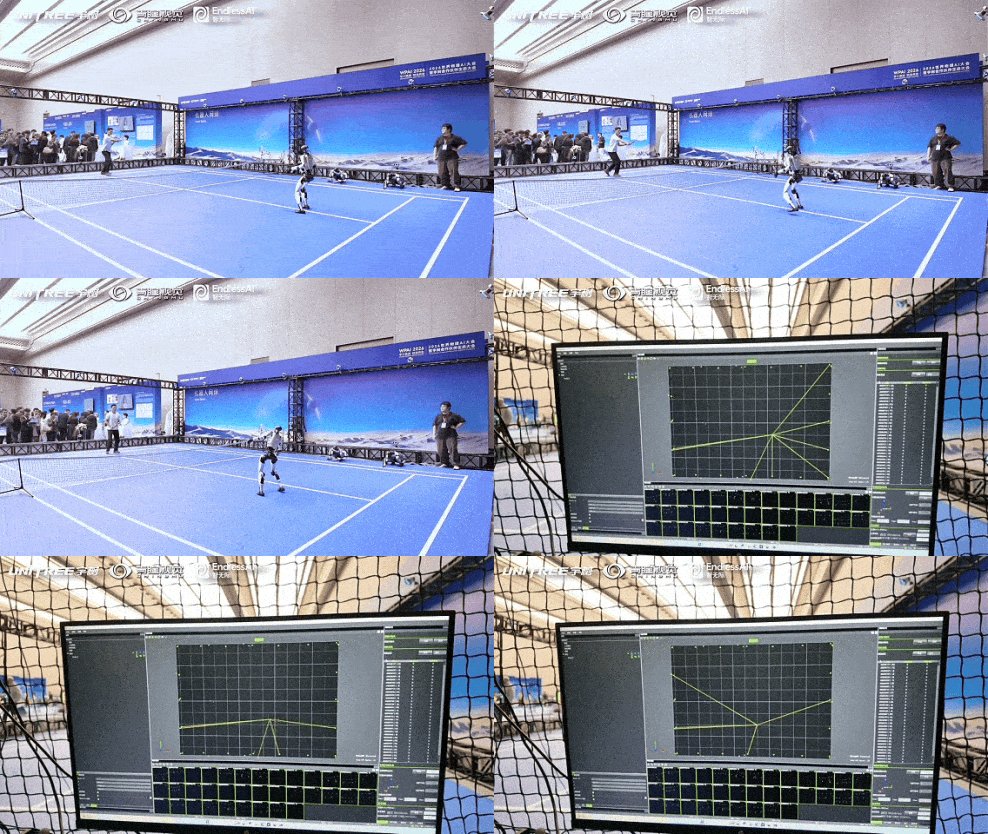
On October 22, the 2026 World Physical AI Conference and Unitree Partner Ecosystem Conference was held at the Hangzhou International Expo Center. Following the table tennis interaction, the Unitree robot tennis demonstration also became a highlight of the event. With a larger court, faster incoming balls, and less predictable landing points, the robot had to judge, move, and swing within an extremely short time.
CHINGMU's motion capture system tracked the 3D spatial positions and motion trajectories of the ball and the robot in real time, continuously feeding external physical information to the models and algorithms that perform trajectory prediction, stroke decision-making, and motion generation.
For a highly dynamic scenario like tennis, "where the ball is, where the robot is, and how the two move relative to each other" is the most fundamental spatial perception input — and an indispensable link between a robot "seeing the ball" and "hitting the ball."
From the table tennis table to the tennis court, the Unitree robot showcased its interaction capabilities across different sports scenarios at the same conference. The high-precision spatial measurement and motion tracking data provided by CHINGMU turn every stroke from "it looked like it hit the ball" into recordable, comparable, iterable evidence.
The high-dynamic motion data accumulated from the tennis demonstration serves not only a one-off showcase, but also a quantifiable basis for the continuous optimization of robot motion algorithms. High-quality motion data is becoming a key variable determining a robot's intelligence, driving Embodied AI from booth demonstrations toward more complex, real-world motion scenarios.


+86-21-56472866 / 13310099680
1190 Nong METACINE (South Gate), Building 1, CHINGMU, Zhengtai Road,Baoshan District, Shanghai

Hot searches: Motion capture, Optical motion capture, Motion capture system robot, Motion capture, Bionic robot, Motion control, Gait analysis, Rehabilitation training action assessment, Animation production, Virtual idol live streaming, Expression capture, Virtual production, Pre-visualization, Performance capture