
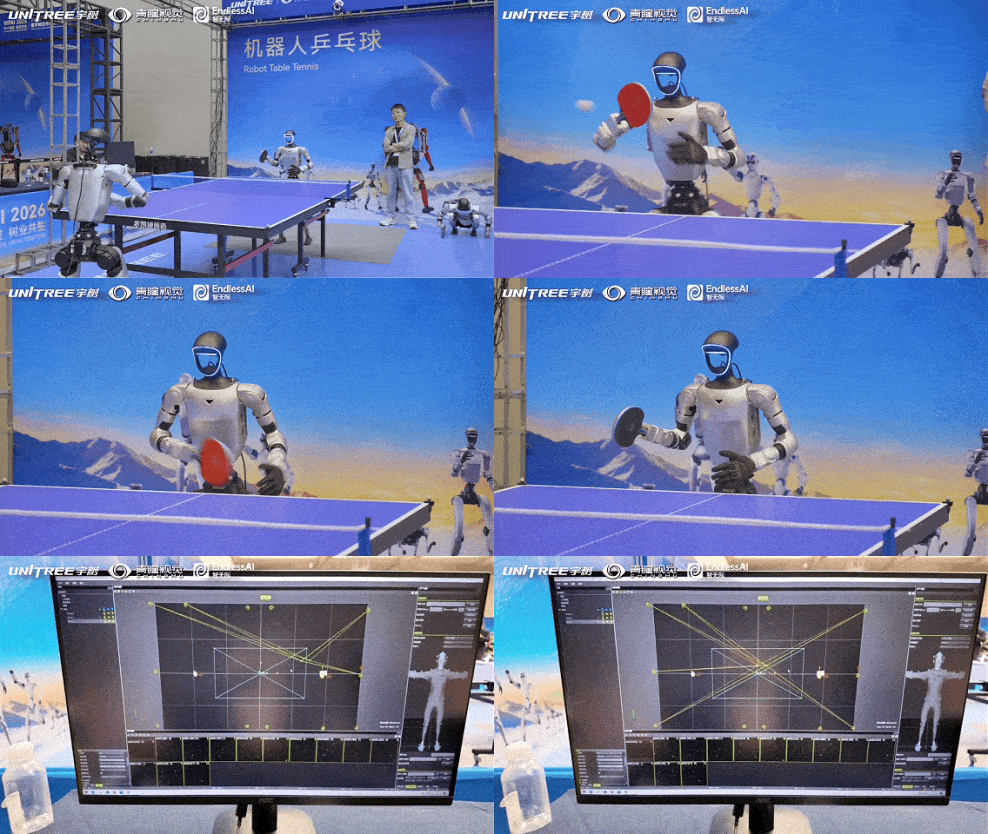
On October 22, the 2026 World Physical AI Conference and Unitree Partner Ecosystem Conference was held at the Hangzhou International Expo Center, where the robot table tennis interaction became one of the most popular exhibits. On one side of the table, a Unitree robot swung and returned high-speed incoming balls — behind the seemingly simple rally runs a complete perception-and-decision chain.
In this demo, CHINGMU's motion capture system handled the very front end of the pipeline: acquiring the spatial positions of the ball and the robot in real time, continuously tracking the high-speed ball's motion trajectory, and feeding this external physical information to the models and algorithms that perform motion prediction, stroke decision-making, and motion generation.
Chen Guang, founder of EndlessAI, summed up CHINGMU's role in two things: "establishing world coordinates on the court and tracking the ball's trajectory in real time." Coordinates and trajectory are precisely the most fundamental — and most indispensable — set of data between a robot "seeing the ball" and "hitting the ball."
The significance of this demo goes beyond a smooth table tennis rally. At a parallel forum, Zhang Haiwei, Founder & CEO of CHINGMU, argued that as AI moves from the digital world into the physical world, high-quality motion data is becoming a key variable determining a robot's intelligence. Just as data powered the internet, high-precision, multimodal, reusable motion data is an indispensable infrastructure of the Physical AI era.
The table tennis table is a miniature proving ground: the ball is fast, its trajectory keeps changing, and rallies are dense, so every stroke tests the quality of coordination among perception, decision-making, and execution. The spatial measurement and motion tracking data provided by CHINGMU turn this validation from "it looked like it hit the ball" into recordable, comparable, iterable evidence.
At the same conference, CHINGMU also became one of the first ecosystem partners of Unitree's Startup & Innovation Program. Starting from the table tennis table, high-precision motion data is becoming a foundation layer for Physical AI as it moves from demonstrations to R&D, and from the booth to real-world scenarios.


+86-21-56472866 / 13310099680
1190 Nong METACINE (South Gate), Building 1, CHINGMU, Zhengtai Road,Baoshan District, Shanghai

Hot searches: Motion capture, Optical motion capture, Motion capture system robot, Motion capture, Bionic robot, Motion control, Gait analysis, Rehabilitation training action assessment, Animation production, Virtual idol live streaming, Expression capture, Virtual production, Pre-visualization, Performance capture