
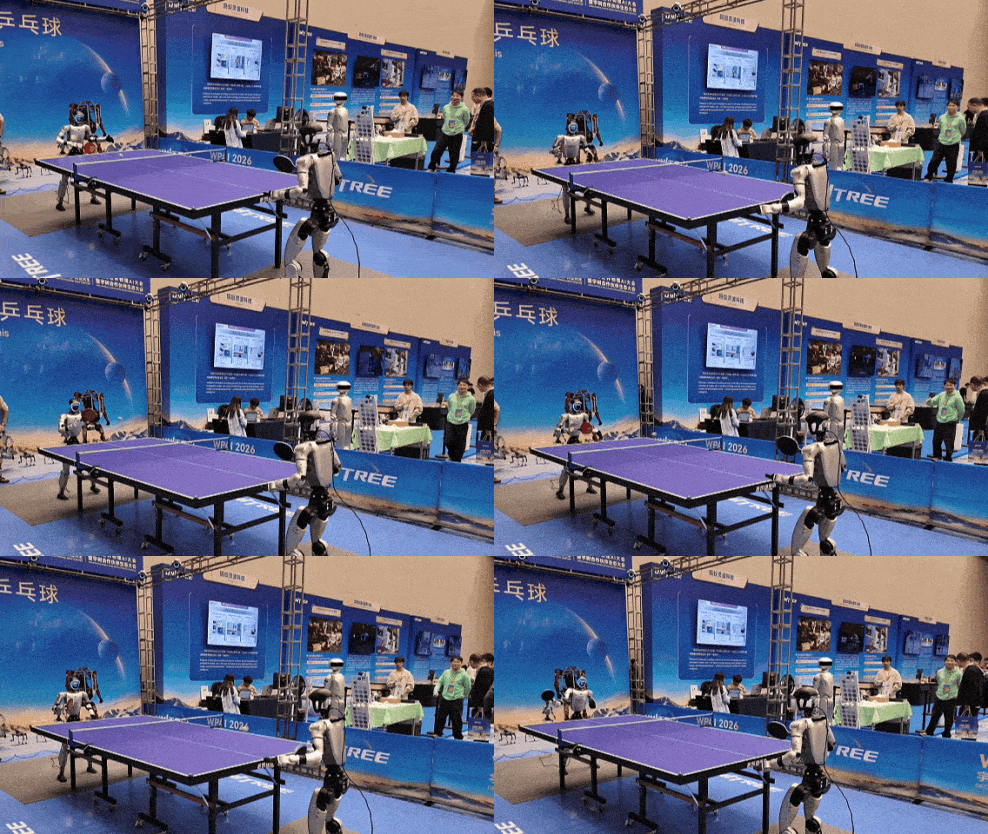
In early October, at AI & Digital Bridge 2026 in Kazakhstan, a Unitree robot stepped up to the table tennis table and rallied back and forth with spectators. A month later, the same scene played out again at RobotWorld 2026 at KINTEX in Goyang, South Korea — crowds gathered at the Unitree booth to watch the robot swing, return, and adjust its footwork. The two expos are thousands of kilometers apart, yet the challenge is the same: a table tennis ball crosses the net in under 0.15 seconds, can travel faster than 15 m/s, and carries spin — so the robot must complete ball detection, trajectory prediction, and stroke decision-making within milliseconds. At both events, CHINGMU's high-precision optical motion capture system tracked the spatial positions and motion trajectories of the ball and the robot in real time, providing external spatial perception input for Unitree's stroke control.
In Kazakhstan, this external perception enabled the Unitree robot to complete strokes steadily against rapidly changing incoming balls. In South Korea, the same capability drew large crowds from the very first day, with visitors watching the robot return shot after shot. The real-time 3D localization and trajectory data provided by CHINGMU mean each swing is no longer just "looking like a completed motion" — it is backed by measurable, comparable spatial data, helping the robot's motion capabilities move from the demo booth toward more real-world interaction scenarios.


+86-21-56472866 / 13310099680
1190 Nong METACINE (South Gate), Building 1, CHINGMU, Zhengtai Road,Baoshan District, Shanghai

Hot searches: Motion capture, Optical motion capture, Motion capture system robot, Motion capture, Bionic robot, Motion control, Gait analysis, Rehabilitation training action assessment, Animation production, Virtual idol live streaming, Expression capture, Virtual production, Pre-visualization, Performance capture