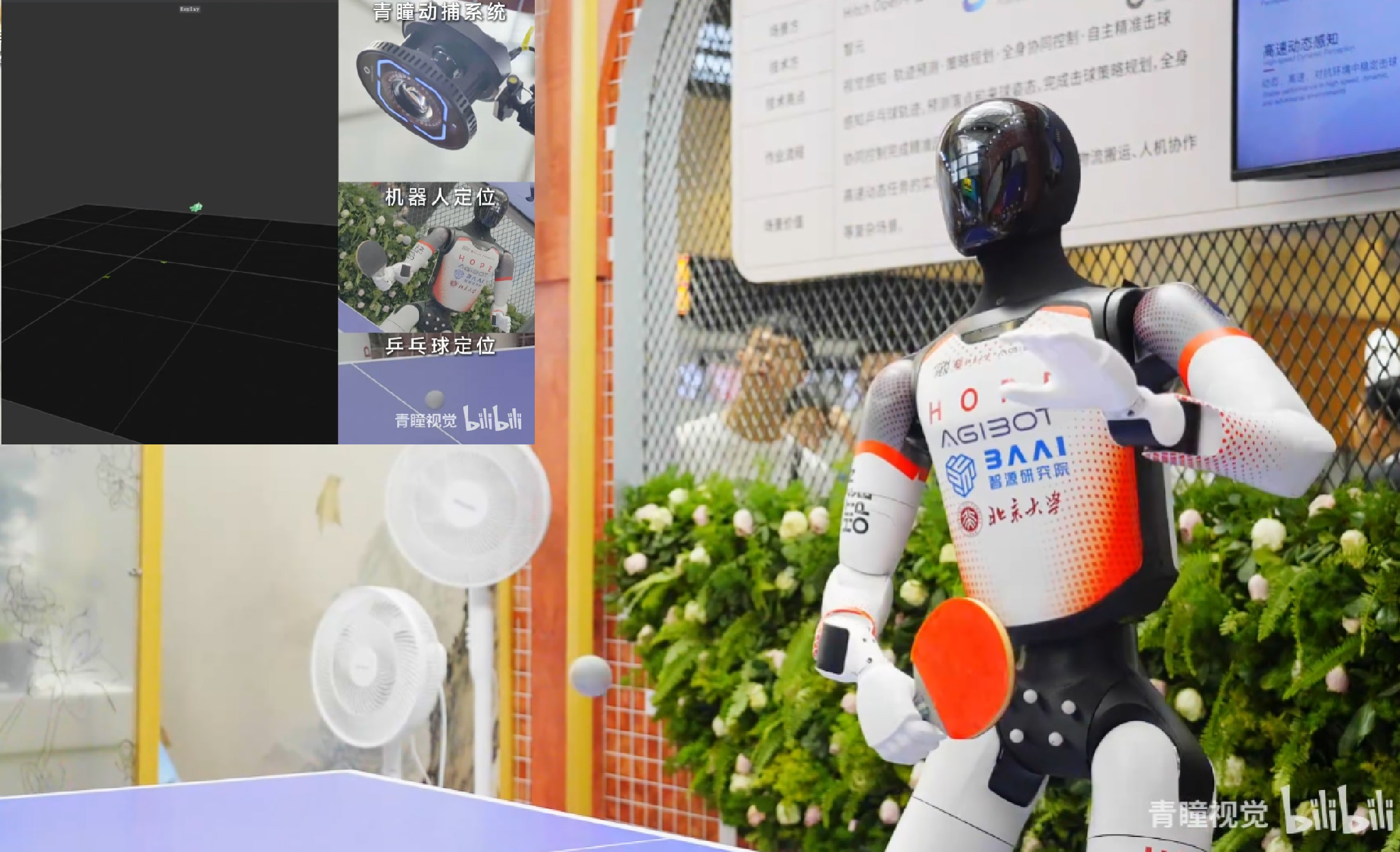
During the 2026 World Artificial Intelligence Conference (WAIC), the HOPE AI autonomous decision-making humanoid robot table tennis exhibition match, jointly presented by AGIBOT, CHINGMU, Peking University, Beijing Academy of Artificial Intelligence (BAAI), UC Berkeley, and other teams, captivated the audience. As the world's first full-size bipedal humanoid robot capable of fully autonomous decision-making and complete table tennis rallies, it engaged in real-time human-robot competition with on-site spectators—without remote control, pre-scripted routines, or human intervention.
Behind every precise swing of the robot, CHINGMU provided critical technical support, deploying the K (Kunpeng) Series K26 motion capture system to capture the 3D trajectory of both the high-speed ball and the robot body at 300fps and sub-millimeter accuracy. By precisely acquiring the real-time spatial position and motion trajectory of the table tennis ball and the robot itself, the robot was enabled to perform full-court movement, autonomous decision-making, and precise striking—just like a human player.
From single-sport demonstrations to more complex human-robot real-time interactions, the demands on robots have grown increasingly higher—high-speed targets, continuous decision-making, real-time feedback, and intricate human-robot interaction, each step testing the capabilities of the entire embodied AI system. CHINGMU continues to provide high-precision 3D spatial perception capabilities for robots, serving as a vital bridge connecting the physical world and robotic intelligent decision-making, and continuously expanding the motion boundaries of robots in real-world dynamic environments.