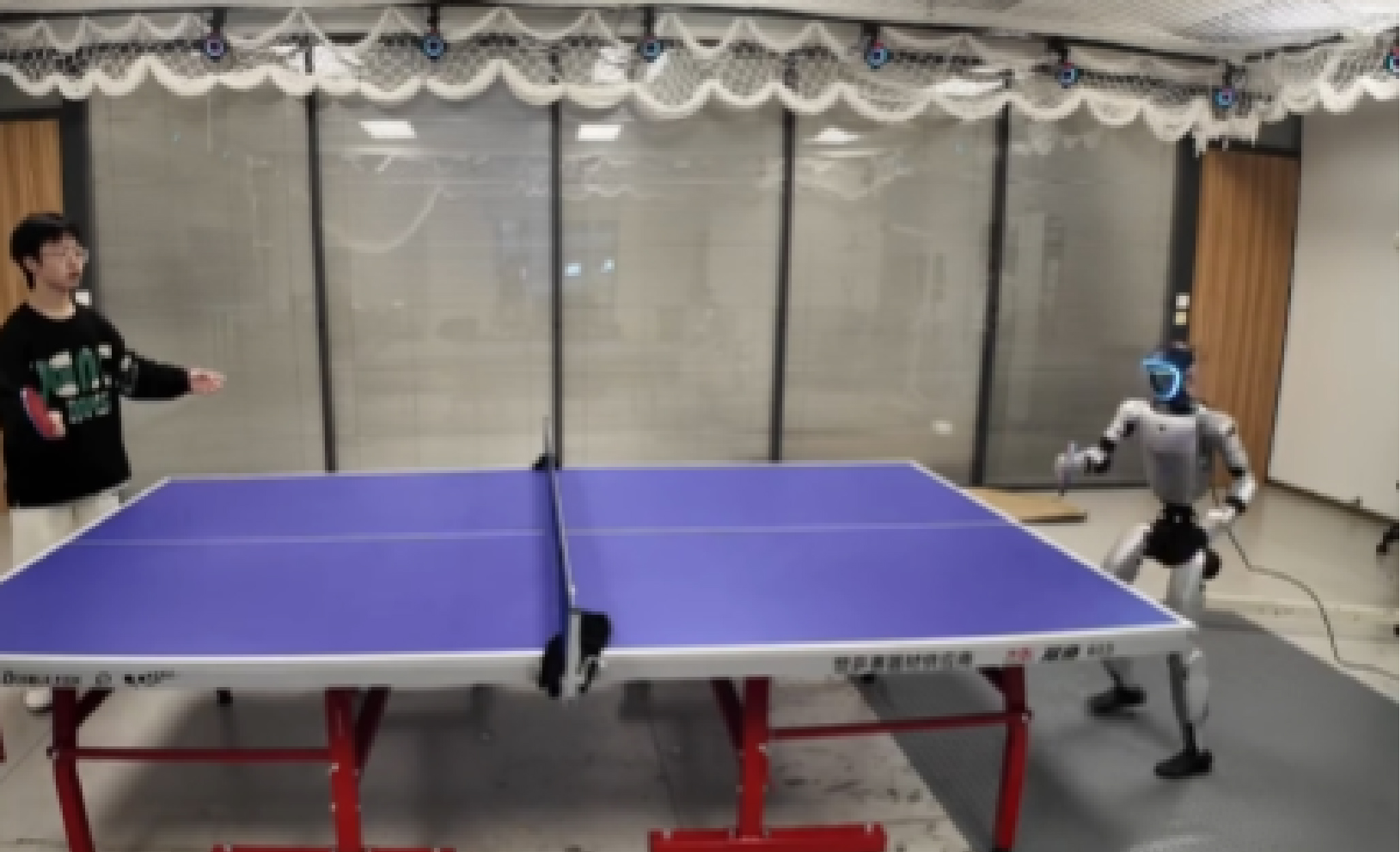
The company's self-developed cloud-collaborative robot scenario intelligence system enables robots to complete the full workflow of trajectory prediction, stable hitting, and rapid repositioning, marking a new breakthrough in motion control capabilities of embodied AI in high-speed dynamic scenarios.
In this technical validation, CHINGMU's optical motion capture system served as the core data infrastructure for robot perception and decision-making. Table tennis is characterized by high ball speed, variable trajectories, and stringent spatial positioning accuracy requirements, making it difficult for traditional vision solutions to simultaneously achieve high-speed capture and high-precision tracking.By deploying a high-performance array of motion capture cameras, CHINGMU simultaneously achieved 6-DoF spatial positioning and pose tracking of both the high-speed flying ball and the robot body. With sub-millimeter accuracy and low-latency capture capability, it completely recorded the ball's flight trajectory, movement posture, and real-time joint motion data of the robot.
The precisely captured motion data was fed into EndlessAI's cloud intelligence system as core training samples, providing reliable data support for model training of hitting strategies, path planning, and motion optimization. This helped the algorithm continuously iterate on hitting timing, racket angle, and repositioning paths, ultimately enabling the robot to achieve continuous and stable table tennis play.
This collaboration validated the core value of optical motion capture technology in the embodied AI field, providing a standardized, high-precision perception solution for robot motor skill learning and dynamic scenario interaction. It also established a replicable technical pathway for complex motion training of more industrial and service robots.