
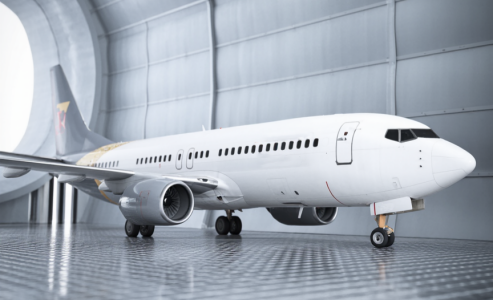
To validate aircraft reliability and structural integrity under extreme meteorological conditions, the AVIC First Aircraft Institute (FAI) conducted China's first wind tunnel test at wind speeds of up to 80 m/s — equivalent to a Category 17+ super typhoon. In this landmark test, the CHINGMU high-precision optical motion capture system delivered critical real-time data support, accurately capturing the dynamic response of aircraft models subjected to extreme airflow conditions.
The system deployed multiple high-speed infrared cameras to achieve stable, sub-millimeter real-time tracking of hundreds of markers distributed across the model surface — performing reliably within a complex test environment characterized by intense airflow and high acoustic interference. The system precisely recorded the model's global displacement, attitude angle variation, local structural deformation, and flutter behavior across multiple load cases, including sustained 80 m/s winds and abrupt gust events — converting subtle dynamic responses imperceptible to the naked eye into high-frequency, quantifiable 3D data streams.
The high-fidelity motion data acquired during testing provided a direct empirical basis for eva1uating aerodynamic stability, structural strength, and fatigue resistance under extreme wind conditions. The dataset further contributes essential ground-truth measurements to support aerodynamic profile optimization, flight control system simulation, and airworthiness safety validation.


+86-21-56472866 / 13310099680
1190 Nong METACINE (South Gate), Building 1, CHINGMU, Zhengtai Road,Baoshan District, Shanghai

Hot searches: Motion capture, Optical motion capture, Motion capture system robot, Motion capture, Bionic robot, Motion control, Gait analysis, Rehabilitation training action assessment, Animation production, Virtual idol live streaming, Expression capture, Virtual production, Pre-visualization, Performance capture