
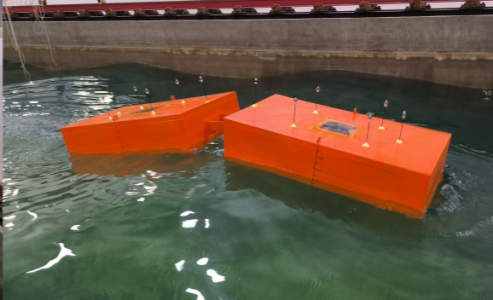
Wave energy represents one of the most promising renewable energy resources in the ocean energy sector, with an energy density five times that of wind power and twenty times that of solar — offering annual generation hours that exceed both, and a global theoretical resource base of approximately 7 billion kilowatts. Despite this potential, the efficient and stable capture and conversion of wave energy into electricity remains a significant challenge for the scientific community. Researchers at institutions worldwide, including Tsinghua University, have explored this domain extensively, developing a range of Wave Energy Converter (WEC) configurations. Among these, the raft-type wave energy converter is widely regarded as one of the most promising device concepts.
In practical applications, however, the hydrodynamic performance of dual-float WECs equipped with mooring systems — and the numerical modeling methodologies used to characterize them — require further development. To address this gap, a research team led by Xu Peng, faculty member at the School of Naval Architecture and Maritime Engineering, Zhejiang Ocean University, together with postgraduate researcher Chen Xuanyu, conducted a systematic performance study of a moored dual-raft wave energy converter. The research provides new analytical perspectives and empirical data to support the development and utilization of wave energy resources. The findings have been published in the internationally recognized Journal of Marine Science and Engineering (JMSE).
The research team applied three-dimensional potential flow theory to conduct an in-depth analysis of the dynamic characteristics of the dual-float wave energy converter. To accurately monitor the motion trajectories of the floating bodies throughout experimentation, the team deployed the CHINGMU MC Series motion capture system — selected for its stable performance, high measurement precision, and outdoor-enhanced capture capability, providing reliable data assurance across all experimental test conditions.
Experimental results demonstrate that under identical wave heights across varying wave periods, the motion response of the floating bodies differs significantly. Equally, notable variation in motion response was observed across different wave heights, with floating body responses under steep wave conditions substantially exceeding those recorded under relatively mild wave conditions. Variations in wave period were also found to exert a significant influence on floating body motion behavior.


+86-21-56472866 / 13310099680
1190 Nong METACINE (South Gate), Building 1, CHINGMU, Zhengtai Road,Baoshan District, Shanghai

Hot searches: Motion capture, Optical motion capture, Motion capture system robot, Motion capture, Bionic robot, Motion control, Gait analysis, Rehabilitation training action assessment, Animation production, Virtual idol live streaming, Expression capture, Virtual production, Pre-visualization, Performance capture