
Exoskeleton robots have seen widespread adoption in rehabilitation medicine and elderly assistance applications in recent years, attracting significant attention from both the medical and engineering communities for their intelligent control capabilities, high adaptability, and demonstrable rehabilitation outcomes. Motion pattern recognition represents a critical component of exoskeleton control systems, playing a pivotal role in enabling human-robot collaboration and improving rehabilitation efficiency. However, conventional recognition methods are limited by insufficient classification accuracy and an inability to fully interpret the complexity of human movement patterns — constraints that have hindered the broader clinical adoption of exoskeleton robotic systems.
The Institute of Intelligent Control for Complex Electromechanical Systems at Kunming University of Science and Technology focused on improving motion pattern recognition accuracy, proposing an enhanced random forest algorithm integrating Particle Swarm Optimization and hierarchical clustering (PSO-RF-KNN-HC). The approach leverages high-precision optical motion capture data to enable efficient recognition of seven fundamental motion patterns, providing more reliable data support for exoskeleton control systems. The research findings have been published in Measurement, a leading international peer-reviewed journal.
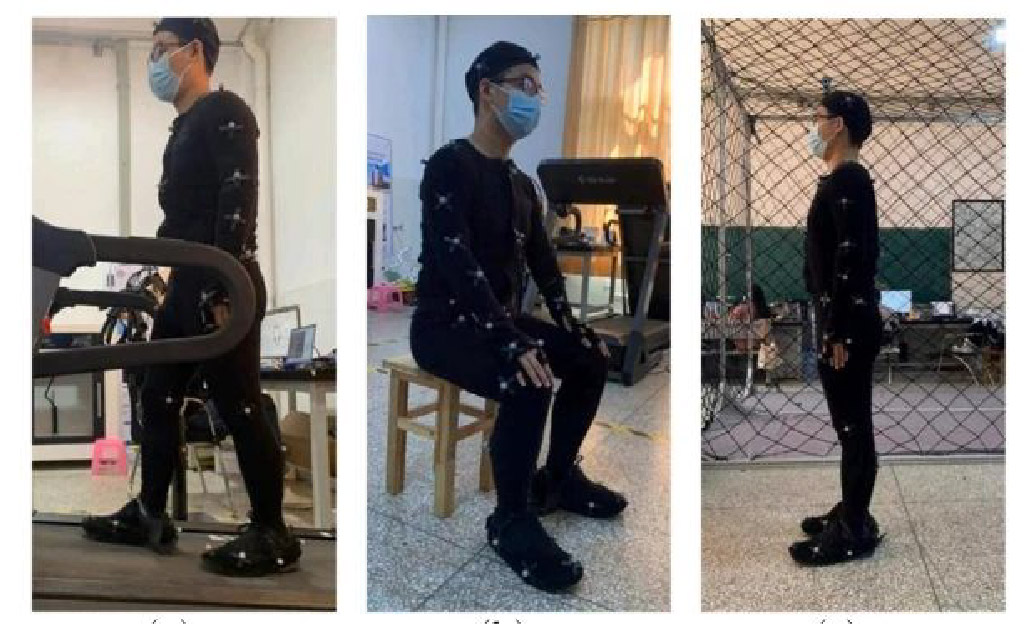
For experimental validation, the team established a real-world motion data acquisition platform using the CHINGMU optical motion capture system. Delivering sub-millimeter positional accuracy and high-frequency data acquisition capability, the system captured real-time motion data from eleven subjects performing seven representative daily activities — level-ground walking, sitting, standing, ascending and descending stairs, and ascending and descending slopes — providing a high-fidelity dataset for algorithm training and validation.
The study demonstrates that a motion recognition framework combining high-precision optical motion capture with an advanced machine learning algorithm offers substantial practical value, significantly enhancing the recognition responsiveness and control efficiency of exoskeleton robotic systems in rehabilitation assistance scenarios. The methodology is applicable across multiple contexts including rehabilitation training, assisted ambulation, and elderly mobility health monitoring — providing effective technical support for intelligent wearable devices and human-robot interaction systems.


+86-21-56472866 / 13310099680
1190 Nong METACINE (South Gate), Building 1, CHINGMU, Zhengtai Road,Baoshan District, Shanghai

Hot searches: Motion capture, Optical motion capture, Motion capture system robot, Motion capture, Bionic robot, Motion control, Gait analysis, Rehabilitation training action assessment, Animation production, Virtual idol live streaming, Expression capture, Virtual production, Pre-visualization, Performance capture