
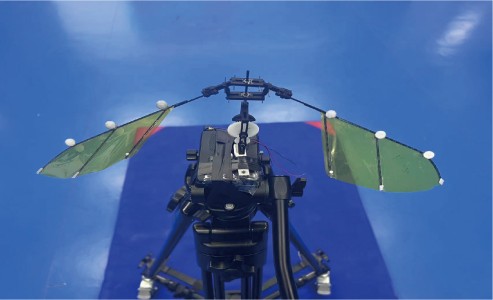
Miniature bionic aerial vehicles have emerged as a major research focus in recent years, distinguished by their compact form factor, high maneuverability, low acoustic signature, strong concealment characteristics, and exceptional aerodynamic efficiency under low Reynolds number conditions. Approximately a decade ago, researchers proposed a novel Flapping Wing Rotor (FWR) architecture that integrates the mechanical principles of both bionic flapping-wing and rotary-wing flight vehicles — a concept whose feasibility has since been validated through extensive experimental work. However, the lift margin of current FWR systems has not yet reached the threshold required to carry useful payloads such as miniature cameras or small packages, limiting their practical deployment across real-world applications.
To address this challenge, Dr. Chen Si and the research team at the School of Mechanical and Electrical Engineering, Wenzhou University, conducted a study titled "Enhancement Effects of Energy Harvesting Technology on the Aerodynamic Efficiency of a Flyable Flapping Wing Rotor System." The research investigates the influence of energy harvesting devices and torsion angle variation on FWR lift generation, with the aim of providing new insights into payload capacity and expanded application potential for FWR platforms. The findings have been published in SCIENCE CHINA Technological Sciences, a leading international journal in engineering and technology.
The experimental setup comprised three integrated subsystems: a lift measurement system, a flight system, and a motion capture system. Within this framework, the CHINGMU optical motion capture system provided precise physical motion capture and visualization of the FWR throughout all test conditions, ensuring the reliability and validity of experimental data. The system was configured with MC4000 motion capture cameras and CMTracker software. Six fluorescent feature points distributed across the wing surface were tracked by the cameras to record time-varying positional data, which was subsequently exported via CMTracker and processed computationally to derive the wing's torsional, rotational, and flapping motion curves.
Research findings demonstrate that both the selection of a preset torsion angle within the 10°–70° range and the application of spring elements can effectively enhance FWR lift efficiency — providing two viable and complementary strategies for further improving the aerodynamic performance of flapping wing rotor systems.


+86-21-56472866 / 13310099680
1190 Nong METACINE (South Gate), Building 1, CHINGMU, Zhengtai Road,Baoshan District, Shanghai

Hot searches: Motion capture, Optical motion capture, Motion capture system robot, Motion capture, Bionic robot, Motion control, Gait analysis, Rehabilitation training action assessment, Animation production, Virtual idol live streaming, Expression capture, Virtual production, Pre-visualization, Performance capture