
Unmanned aerial vehicles have established an indispensable role as aerial robotic platforms in recent years. Quadrotors are particularly well-suited to operations in confined spaces, offering low acoustic emissions, zero pollution, and convenient portability — characteristics that make them highly effective for short-to-medium range flight missions. However, the compact structural dimensions and limited endurance of individual quadrotors result in insufficient payload transport capacity for single-vehicle operation, constraining their practical application value. Multi-UAV systems address this limitation through complementary capability distribution and coordinated action, achieving significant improvements in overall system effectiveness and substantially enhancing collective payload transport capacity.
To enable safe and efficient collaborative suspended transport operations using quadrotors, Professor Rao Jinjun's research team at the School of Mechatronic Engineering and Automation, Shanghai University, conducted a systematic investigation into path planning strategies for dual-quadrotor collaborative transport systems. The team proposed a novel Artificial Potential Field–A* (APF-A*) hybrid algorithm, with findings published in Knowledge-Based Systems, a leading international peer-reviewed journal.
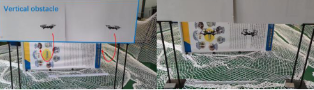
Throughout algorithm development and validation, the team constructed an experimental platform using the CHINGMU optical motion capture system, conducting joint verification of quadrotor collaborative flight control and path planning across both AirSim virtual simulation environments and real-world test scenarios. Results confirm that the proposed algorithm provides safe and reliable navigation trajectories for dual-UAV collaborative transport operations, successfully enabling the wingman UAV to execute dynamic formation reconfiguration in the vicinity of obstacles — ensuring the safe and stable transport of suspended payloads throughout the mission.
In future research, the team will incorporate additional disturbance factors into simulation environments — including wind velocity, airflow turbulence, and dynamic obstacle interference — to enhance algorithm robustness and broaden the applicable operational scenarios for quadrotor payload transport systems.


+86-21-56472866 / 13310099680
1190 Nong METACINE (South Gate), Building 1, CHINGMU, Zhengtai Road,Baoshan District, Shanghai

Hot searches: Motion capture, Optical motion capture, Motion capture system robot, Motion capture, Bionic robot, Motion control, Gait analysis, Rehabilitation training action assessment, Animation production, Virtual idol live streaming, Expression capture, Virtual production, Pre-visualization, Performance capture