
Wheeled Mobile Robots (WMRs) are widely deployed across exploration, logistics, and search-and-rescue applications, valued for their structural simplicity and high maneuverability. In practice, however, complex ground conditions — including wet or slippery surfaces and sharp turning maneuvers — frequently introduce sliding disturbances that significantly degrade trajectory tracking accuracy, limiting the effective deployment of WMRs in real-world engineering environments.
To overcome this challenge, Professor Wang Xiangyu's research team at the School of Automation, Southeast University, addressed the precision control problem under sliding disturbance conditions by proposing an innovative Virtual Reference Trajectory Scheme (VRTS) designed to substantially enhance WMR trajectory tracking performance in complex operational environments. The findings have been published in Transactions of the Institute of Measurement and Control, an international SCI-indexed journal.
The proposed VRTS departs fundamentally from conventional disturbance compensation approaches. Rather than applying compensation within the controller, the scheme incorporates sliding disturbance estimation directly into the reference trajectory generation process: disturbance estimates are first fused to construct a virtual trajectory, which the controller then drives the robot to track — achieving precise following of the true desired trajectory. The scheme delivers three key advantages: significantly improved compensation efficiency for both longitudinal and lateral sliding disturbances; a novel disturbance approximation method derived from odometry error derivatives, offering streamlined parameterization and strong engineering adaptability; and high compatibility with existing controller architectures, preserving original tracking performance in disturbance-free operating conditions.
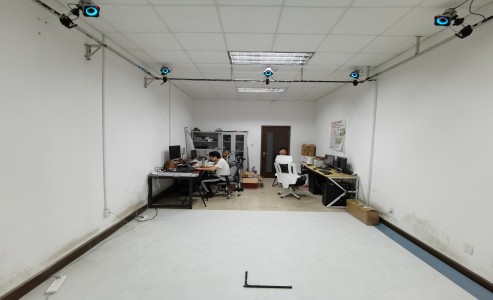
For experimental validation, the team constructed a test platform using the CHINGMU high-precision optical motion capture system. Operating at a sampling frequency of 100Hz, the system delivered real-time capture of WMR position and trajectory data with sub-millimeter localization accuracy, low latency, and full-volume coverage — providing the critical data infrastructure required for VRTS validation. Comparative eva1uation against a Pure Vision Feedback Scheme (VFS) and an Odometry Feedback Scheme (OFS) demonstrated that VRTS achieves significant advances in both distance tracking Error Boundary (EB) and Mean Absolute Error (MAE) metrics, successfully converging sliding disturbance-induced distance tracking error to zero — confirming the exceptional performance of the proposed control framework.


+86-21-56472866 / 13310099680
1190 Nong METACINE (South Gate), Building 1, CHINGMU, Zhengtai Road,Baoshan District, Shanghai

Hot searches: Motion capture, Optical motion capture, Motion capture system robot, Motion capture, Bionic robot, Motion control, Gait analysis, Rehabilitation training action assessment, Animation production, Virtual idol live streaming, Expression capture, Virtual production, Pre-visualization, Performance capture