
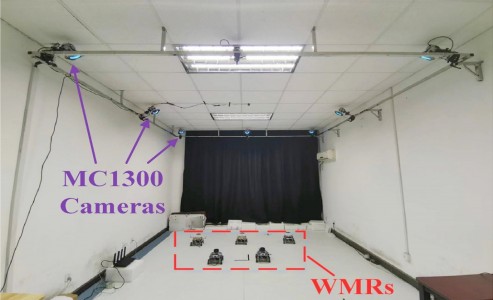
While the deployment of individual Wheeled Mobile Robots (WMRs) in industrial transport applications has become well established, collaborative transport systems involving multiple WMRs remain an active area of research and development. Many conventional collaborative control algorithms are designed directly on the basis of cooperative tracking error — an approach that leaves room for improvement in terms of both algorithmic complexity and operational flexibility.
Professor Wang Xiangyu's research team at Southeast University proposed a collaborative transport formation control algorithm for multiple WMRs, specifically addressing the challenges of multi-robot coordinated transport operations. The findings have been published in Control Engineering Practice, a leading international journal in the field of control engineering.
In the course of control algorithm development, the team required a high-precision motion capture solution to provide accurate data reference for algorithm validation. Leveraging the sub-millimeter localization accuracy and high-precision capture performance of the CHINGMU motion capture system, the team achieved real-time acquisition of WMR position, yaw angle, and travel trajectory data — delivering the precise measurement reference required for algorithm validation and ensuring the authenticity and reliability of all experimental results.
Experimental Results:
Test area: 3.8m × 4.5m
Formation: 3 WMRs form an equilateral triangle within 5 seconds
Stability: Maintained for 20 seconds
Transport: Reduced distance tracking error
The system ensures data accuracy and experimental reliability, supporting scalable multi-robot coordination research for logistics and industrial applications.


+86-21-56472866 / 13310099680
1190 Nong METACINE (South Gate), Building 1, CHINGMU, Zhengtai Road,Baoshan District, Shanghai

Hot searches: Motion capture, Optical motion capture, Motion capture system robot, Motion capture, Bionic robot, Motion control, Gait analysis, Rehabilitation training action assessment, Animation production, Virtual idol live streaming, Expression capture, Virtual production, Pre-visualization, Performance capture