
2023/12/22
Mike Grieve, Commercial Director at Mo-Sys, addresses common misconceptions about the evolution of virtual production in this article for The Black Book: Busting the Three Big Virtual Production Myths!
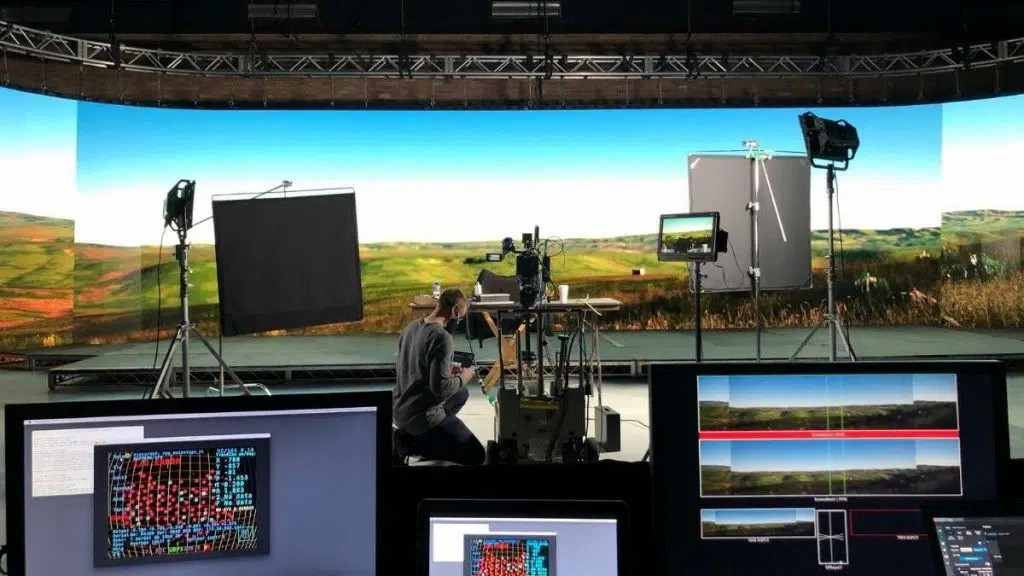
Did you know Disney+’s The Mandalorian brought its iconic galaxy to life using LED virtual production? It’s understandable if you’ve heard of it. It is arguably the most high-profile example of virtual production to date, even years after the series first began streaming. But are you also aware that The Mandalorian was far from the first time filmmakers adopted this technology?
While the LED volume setup used on the show to create otherworldly planets for Mando’s adventures was relatively new at the time, computer-graphics-based virtual production itself was not. In fact, it dates all the way back to 1995.
That is because “virtual production” is an umbrella term covering a whole suite of technologies that have driven progress in filmmaking since the birth of cinema. It includes motion capture, green screens, LED volumes, previsualization, and any content creation workflow involving tracked 3D computer graphics.
Tempting as it may be, this also means the aforementioned LED volumes do not represent the peak of virtual production’s potential. In reality, the technology can evolve in countless ways — and it already is.
If thirty years working in production has taught me anything, it is that you need to learn fast. With that in mind, let us tackle the three most prevalent misconceptions surrounding the fast-evolving world of virtual production.
With all the current excitement around virtual production, you could be forgiven for thinking it was invented just two years ago. But if you have ever watched a classic Hollywood film featuring moving backgrounds speeding past a stationary prop car, you have witnessed virtual production technology in action. While what we see today may look primitive, it is not worlds away from the LED volumes commonplace on virtual production sets back in 2022.
Likewise, you may have seen major leaps forward in virtual production over the past decades. For example, audiences in the 2000s were captivated by the CGI transformation of Andy Serkis as Gollum in Peter Jackson’s The Lord of the Rings trilogy. Motion capture, another key component of filmmaking technology, falls under the umbrella of virtual production. Its roots stretch back to the 1960s, when animator Lee Harrison III experimented with a series of analog circuits, cathode ray tubes and adjustable resistors.
Virtual production, therefore, is not a brand-new technological innovation. Rather, it represents the next evolutionary stage that filmmaking has been progressing toward ever since the first film camera.
As with any cutting-edge technology in film, people expect it will initially be reserved for Hollywood blockbusters. When it comes to virtual production, this misunderstanding has been further reinforced by ubiquitous examples such as The Mandalorian and the 2019 The Lion King.
But while virtual production is widely used in Hollywood, its utility extends far beyond it. In fact, the technology can deliver cost savings that appeal to any production team. Think of it as a reordering of the entire production workflow. Your 3D computer graphics assets are prepared at full quality in pre-production, and post-production compositing becomes part of the shoot itself. This cuts down post-production time and eliminates on-set errors.
Furthermore, the ability to make creative decisions earlier in the production process results in cleaner shots. Decisions are made while actors are present, rather than fixing costly mistakes in post-production or — even less conveniently — reshooting scenes. Most importantly, virtual location scouting removes travel expenses and even reduces our carbon footprint.
The true magic of virtual production, however, is that it is not a cheap substitute for “the real thing”; it is simply an alternative approach. As noted in a 2020 Deloitte report: “With traditional production methods, Hollywood may be hitting the limits of efficiency. The mindset and toolset of virtual production can not only support better creative outcomes, but also deliver substantial time and cost savings.”
What holds true for Hollywood applies equally to other industries.
There is usually a grain of truth in any good myth, and this is a perfect example. Video game engines — most notably Epic Games’ Unreal Engine and Unity 3D — form the foundation for many virtual production techniques. This is because these engines can generate photorealistic visuals and run in real time, enabling instant responses to filmmakers’ inputs.
At the end of the day, to see the full picture, you must recognize that “virtual production” is an umbrella term describing an entire toolkit of filmmaking techniques. Beyond these game engines, there are incredibly practical technologies such as on-set compositing using LED volumes and the motion capture software mentioned earlier.
Modern filmmakers can select from a wide array of virtual production technologies to bring their projects to life, ranging from LED volumes to the relatively old-school green screen, or even shooting using both at the same time.
如果你想把这篇内容改成适合公众号发布的新媒体稿件,工作任务模式可以优化标题、开篇、配图建议与排版,需要试试吗?





+86-21-56472866 / 13310099680
1190 Nong METACINE (South Gate), Building 1, CHINGMU, Zhengtai Road,Baoshan District, Shanghai

Hot searches: Motion capture, Optical motion capture, Motion capture system robot, Motion capture, Bionic robot, Motion control, Gait analysis, Rehabilitation training action assessment, Animation production, Virtual idol live streaming, Expression capture, Virtual production, Pre-visualization, Performance capture