

2023/02/09
Lacking sufficient support from muscles and bones, female breasts are mainly held by the suspensory ligaments, assisted by superficial fascia and skin. During physical exercise, external support is required to lift the breast upward to reduce strain on its internal tissues. This alleviates vibration‑induced discomfort and prevents long‑term health problems such as breast ptosis, which constitutes the core shock‑absorbing function of sports bras.
Existing research indicates that studies on the shock‑absorbing mechanism of sports bras should focus on the interaction between the breast‑bra system. Future investigations are expected to quantify the relationship between breast displacement and two categories of parameters, namely fabric properties and structural design, so as to optimize the vibration‑reduction performance of sports bras from an essential perspective.

Against this research background, Associate Professor Chen Xiaona from Shanghai University of Engineering Science and her student Sheng Xinyang carried out a study on how fabric elastic modulus affects the shock‑absorbing performance of sports bras. The project was supported by the National Natural Science Foundation of China and an open‑fund program of the Key Laboratory of Modern Fashion Design & Technology (Donghua University), Ministry of Education.
CHINGMU’s self‑developed MC optical motion‑capture system helped the research team break through experimental limitations, cut research costs and capture highly‑accurate motion data to ensure smooth project implementation.
Eight female participants wore two versions of identical‑style sports bras made from different fabrics: Test Garment 1 contained 30 % spandex, while Test Garment 2 contained 20 % spandex. Subjects performed rope‑skipping exercises. Breast displacement during movement and subjective comfort ratings were recorded for each sample.
Five marker points were attached to each participant’s torso: suprasternal notch (M1), bilateral nipple landmarks (M2, M3), and two points horizontally aligned with the nipples at the inferior border of the 10th rib on each side (M4, M5). A torso‑centered coordinate system was established using M1, M4 and M5 as reference markers, with M2 and M3 representing the right and left breasts respectively.
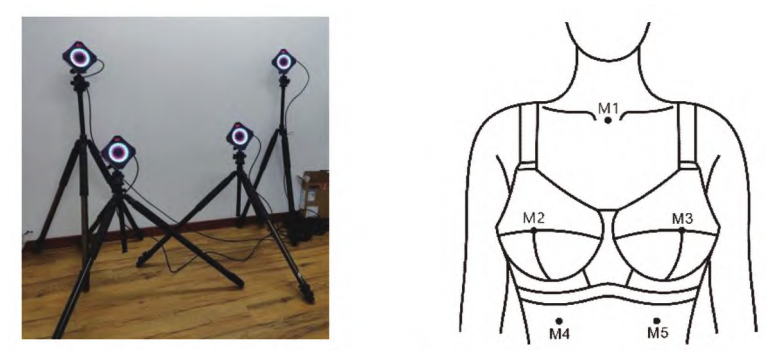
Four CHINGMU MC optical motion‑capture cameras were deployed to record marker trajectories. Raw coordinates under the laboratory coordinate system were converted into torso‑relative coordinates for calculating relative displacement. Since rope‑skipping mainly generates vertical torso motion, only vertical breast displacement was analyzed in this research.
CHINGMU provided both passive and active optical motion‑capture solutions for this soft‑body, sub‑millimeter‑precision experiment. Active‑marker tracking maintains stable marker‑ID assignment throughout motion, enabling researchers to consistently match marker‑position data.
CHINGMU’s R&D team customized special software functions to export marker data in TRC format. This streamlined data collection, simplified workflows and improved experimental efficiency and measurement accuracy.
Prior to adopting CHINGMU’s equipment, the research team had tested 12 cameras from an overseas motion‑capture brand. That solution proved costly and failed to meet data‑quality requirements. By using only four MC‑series cameras, CHINGMU resolved both technical and budget‑related challenges and delivered the complete dataset within the tight research schedule.
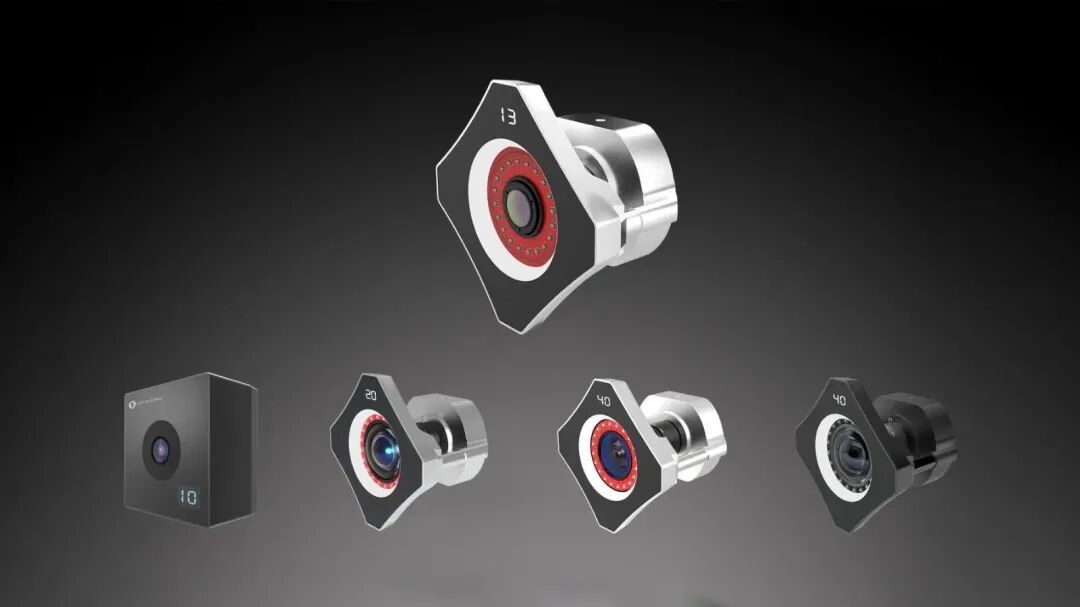
At a jumping frequency of 2 Hz, the average vertical breast displacement of the eight participants reached 15.8 mm for Garment 1 and 16.7 mm for Garment 2, showing Garment 1 < Garment 2 in vibration amplitude. Powered by CHINGMU MC‑series optical motion‑capture system, sub‑millimeter‑level measurement data was successfully obtained.
The average subjective discomfort score caused by breast bounce was 1.17 for Garment 1 and 1.00 for Garment 2, following exactly the same trend as vertical breast displacement.
Analysis reveals that displacement magnitude is inversely correlated with fabric elastic modulus: higher elastic modulus yields better shock‑absorbing performance for sports bras.
With CHINGMU MC‑series optical motion‑capture system, the research group adopted an objective evaluation method. The equipment recorded torso and breast trajectories of subjects wearing sports bras, allowing quantitative assessment of shock‑absorbing performance. Optical motion‑capture converts experimental outcomes into visualized numerical data, delivering superior accuracy and repeatability.
[1] Sheng Xinyang, Chen Xiaona. Influence of Fabric Elastic Modulus on the Shock‑Absorbing Performance of Sports Bras[J]. Journal of Zhejiang Fashion Institute of Technology, 2022(02). [2] Sheng Xinyang, Chen Xiaona, Wang Jianping. Evaluation and Mechanism Research on the Shock‑Absorbing Performance of Sports Bras[J]. Knitting Industries, 2022(10).
CHINGMU Joins OpenLET Community to Co‑Build an Open Ecosystem for Human Motion Data
On August 27 CHINGMU Shanghai Vision Technolog...




+86-21-56472866 / 13310099680
1190 Nong METACINE (South Gate), Building 1, CHINGMU, Zhengtai Road,Baoshan District, Shanghai

Hot searches: Motion capture, Optical motion capture, Motion capture system robot, Motion capture, Bionic robot, Motion control, Gait analysis, Rehabilitation training action assessment, Animation production, Virtual idol live streaming, Expression capture, Virtual production, Pre-visualization, Performance capture
